
Donna gives the full truth on Castaways’ and ‘Liar, Liar’
Trending
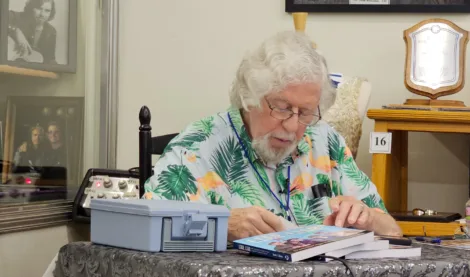
NEW ULM -- The Minnesota Music Hall of Fame hosted Castaways keyboardist Jim Donna on Saturday to discuss the 60th anniversary of the band's 1965 single “Liar, Liar” and his self-published memoir.
Donna discussed the band's progression from local garage rehearsals to national concert tours.
The presentation focused on the early influences that shaped the band’s development in the Twin Cities.
Donna pointed to a 1962 meeting with Jerry Lee Lewis behind the Dance Land Ballroom in Excelsior as his primary inspiration to play rock keyboard.
At age 16, Donna drove his father's 1957 Chrysler New Yorker to the venue, where Lewis demonstrated piano techniques for “Great Balls of Fire” following the show.
In May 1963, Donna graduated from DeLaSalle High School and enrolled at the University of Minnesota for electrical engineering.
That summer, his father secured him a job as an electronics technician at Ault Magnetics making $1.00 per hour, manufacturing components for Control Data computers.
After an audition with The Trashmen resulted in the group hiring a guitarist instead of a keyboard player, Donna received a call from high school students forming a group called The Four Castaways.
To join the band for an audition, Donna loaded his father's heavy console organ into the trunk of his car, prompting a neighbor to call the police believing a burglary was in progress.
Joined by Donna, the group became The Five Castaways, featuring Roy Merlin Hensley on rhythm guitar, Dennis Reed Craswell on drums, Armond Richard “Dick” Roby Jr. on bass guitar, Bob Folschow on lead guitar, and Donna on keyboards.
The group booked its first gig at Miller's Pizza in Richfield for $50 and a free pizza, earning each member $10.
To replace the non-portable console organ, Donna purchased a Wurlitzer electric piano.
Utilizing his technical background as an amateur ham radio operator, he rewired the instrument’s output jack with an inexpensive resistor to play through a guitar amplifier, which led to a side business rewiring electric pianos for other local musicians at his parents’ house.
By June 1964, the band joined the Minneapolis Musicians Union Local #73 to book larger venues.
To transport their equipment, the band purchased a 1955 Cadillac hearse and ambulance combination vehicle for $300 from a small-town dealer, using it to haul gear and five band members to dates across the region.
In March 1965, Donna wrote the core organ riffs and lyrics for “Liar, Liar” at his parents' home in Northeast Minneapolis.
Sitting at his father’s organ, he scribbled down lyrics while his younger sister JoAnne offered suggestions.
Donna collaborated with Craswell to finish the arrangement before presenting the song to the band in their basement rehearsal space. The group recorded a working draft on a portable reel-to-reel tape recorder to refine the arrangement before booking studio time.
On April 3, 1965, the band recorded “Liar, Liar” at Kay Bank Studios at 2541 Nicollet Avenue in South Minneapolis.
Engineered by Tom Jung and produced by Timothy D. Kerr, the session utilized a three-track Ampex analog tape recorder. Donna played the studio’s Hammond B-3 organ through Leslie speakers, Folschow sang the opening falsetto lines, and Roby added an unscripted scream prior to the guitar solo.
Ira Heilicher attended the session and brought the master tape to his father, Soma Records president Amos Heilicher, who signed the band to a recording contract.
Released in mid-1965, “Liar, Liar” reached No. 1 on local charts before peaking at No. 12 on the Billboard Hot 100 chart, remaining on the national charts for 33 weeks.
In early September 1965, Soma Records called the band to report top-40 chart positions on both coasts.
On September 8, 1965, the band returned to Kay Bank Studios from 7:00 p.m. to 10:00 p.m. to record their follow-up single, “Goodbye Babe,” written by Hensley, with Folschow’s “A Man’s Gotta Be a Man” on the B-side.
On September 9, 1965, the group flew to California for a promotional tour organized by General Artists Corporation and booking agent T.B. Skarning.
Upon arrival at the Los Angeles airport, car rental agents initially questioned their ages before renting them two Volkswagen sedans to transport their gear.
While staying at the Hollywood Landmark Motor Hotel, Donna met Cass Elliot at the hotel pool prior to the formation of The Mamas and the Papas.
The California tour included appearances on national television shows including “Where the Action Is,” “Hollywood A Go-Go,” “Shivaree,” “Never Too Young,” and “Hollywood Discotheque,” alongside concert dates supporting The Beach Boys.
City Mouse founder Bobby Drengler attended the Saturday presentation and discussed the mid-1960s shift in regional venues with Donna.
Drengler said the movement from large ballroom venues to smaller tavern settings represented a major structural change for upper Midwest musicians during that decade.
“Moving out of the ballrooms and into the bars was quite a change,” Drengler said.
Donna said the group focused strictly on performance details during their peak national popularity rather than public attention.
“We didn’t think of ourselves as rock stars,” Donna said. “We were just musicians doing our thing.”
Donna left the active lineup in 1966 to resume his college education, earning an associate degree from the University of Minnesota before establishing a career in real estate appraisal.
He reformed The Castaways in 1973 and continued performing until concluding the band’s final farewell tour in 2025.
His book, Liar, Liar: From Garage Band to Rockstars, The Story of Minnesota's Castaways in the 1960s, is archived at the Minnesota Music Hall of Fame and is available through the band's website.
—