
Sveine preserves Loeffelmacher legacy
Research highlights how the Six Fat Dutchmen built a national music empire
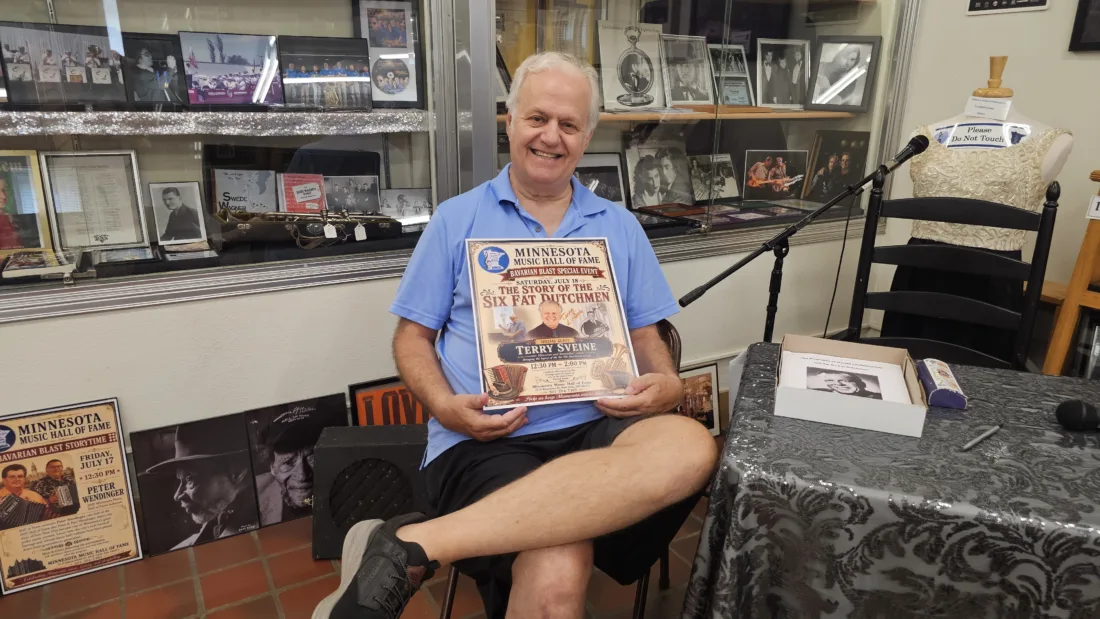
Local historian Terry Sveine holds an event flyer detailing his historical presentation on bandleader Harold Loeffelmacher and the Six Fat Dutchmen at the Minnesota Music Hall of Fame. (Photo by Amy Zents)
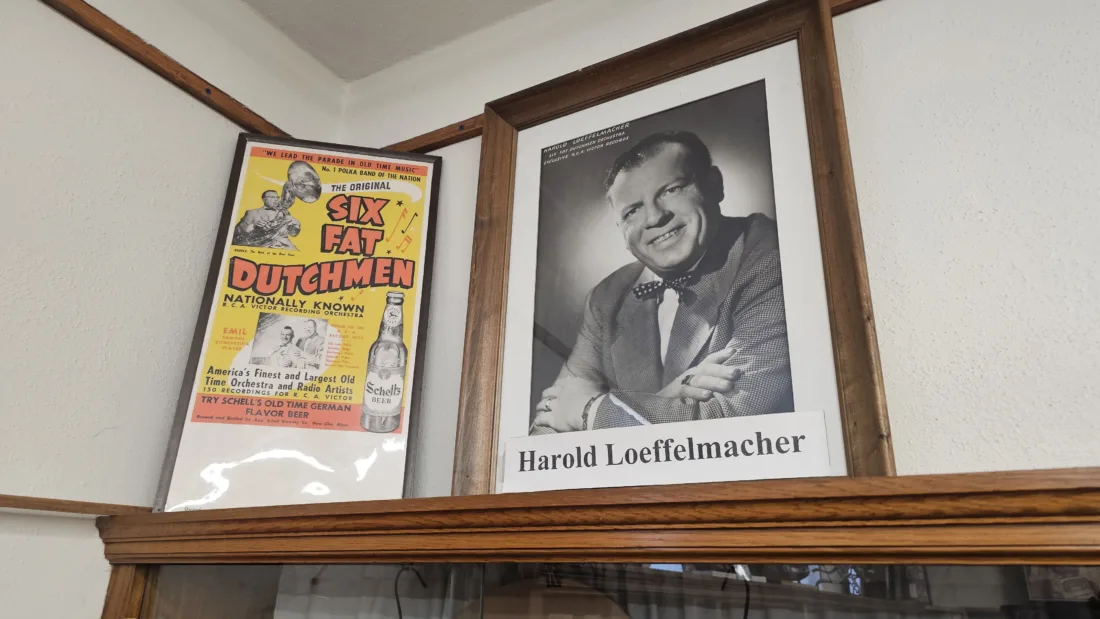
A framed portrait of bandleader Harold Loeffelmacher alongside vintage promotional artwork for the Six Fat Dutchmen is featured in the museum's exhibit gallery. (Photo courtesy of the Minnesota Music Hall of Fame)
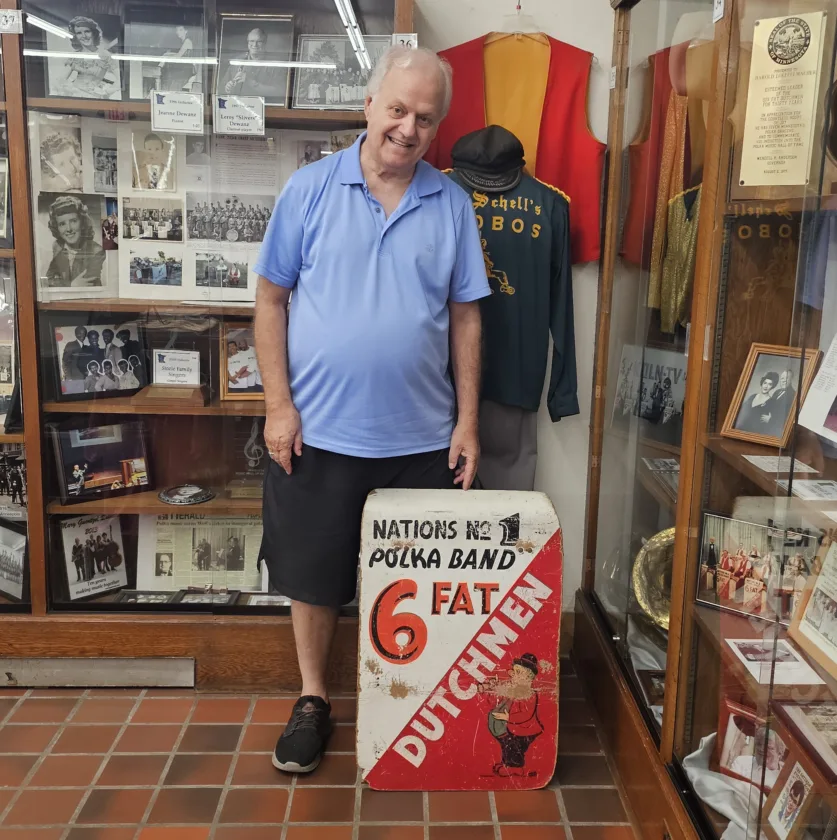
Local historian Terry Sveine stands beside an original stage music stand display used by the Six Fat Dutchmen at the Minnesota Music Hall of Fame. (Photo by Amy Zents)
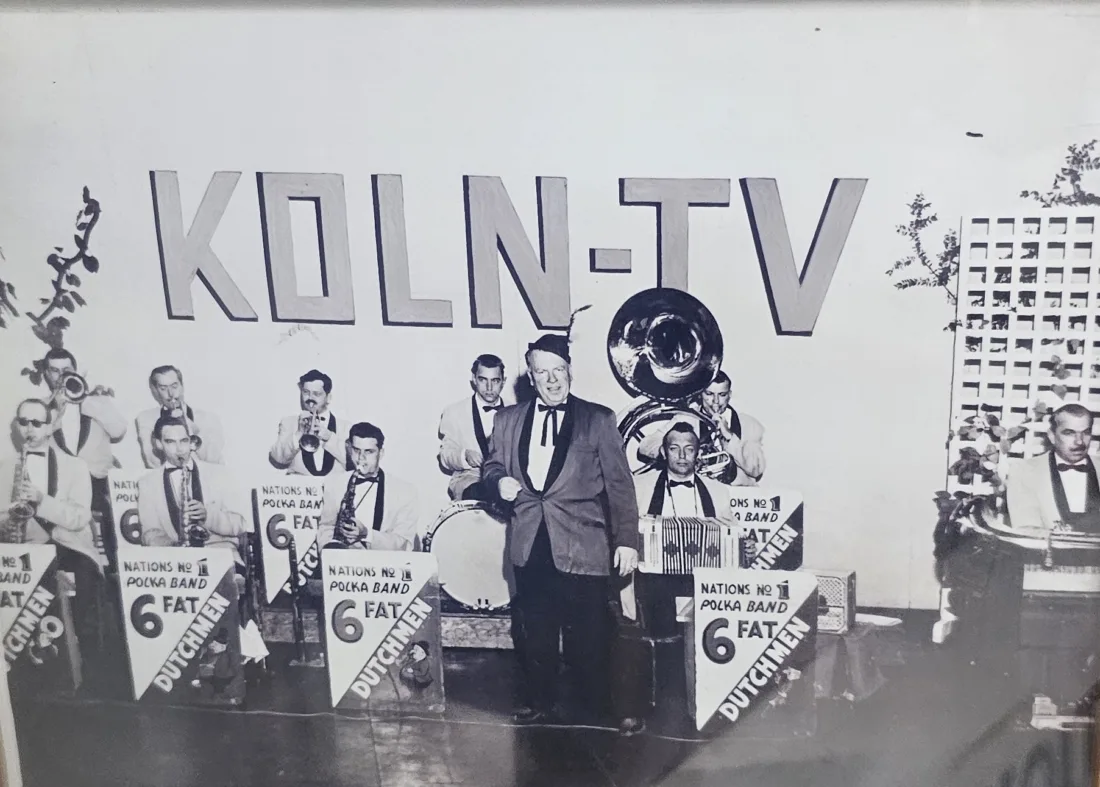
Harold Loeffelmacher and the Six Fat Dutchmen pose during a broadcast appearance on KOLN-TV, part of the archival collection on display at the Minnesota Music Hall of Fame. (Photo courtesy of the Minnesota Music Hall of Fame)
Local historian Terry Sveine holds an event flyer detailing his historical presentation on bandleader Harold Loeffelmacher and the Six Fat Dutchmen at the Minnesota Music Hall of Fame. (Photo by Amy Zents)
A framed portrait of bandleader Harold Loeffelmacher alongside vintage promotional artwork for the Six Fat Dutchmen is featured in the museum's exhibit gallery. (Photo courtesy of the Minnesota Music Hall of Fame)
Local historian Terry Sveine stands beside an original stage music stand display used by the Six Fat Dutchmen at the Minnesota Music Hall of Fame. (Photo by Amy Zents)
Harold Loeffelmacher and the Six Fat Dutchmen pose during a broadcast appearance on KOLN-TV, part of the archival collection on display at the Minnesota Music Hall of Fame. (Photo courtesy of the Minnesota Music Hall of Fame)
Trending
NEW ULM -- Standing inside the Minnesota Music Hall of Fame (MMHF) beside an exhibit case filled with vintage brass instruments, sheet music, and framed portraits, local historian Terry Sveine reflected on a central figure in American polka history.
Sveine was recently at the MMHF as part of an ongoing historical presentation series, sharing his detailed research on bandleader Harold Loeffelmacher and the Six Fat Dutchmen.
In 1999, Sveine compiled a comprehensive historical report on bandleader Harold Loeffelmacher and the Six Fat Dutchmen, tracing Loeffelmacher's life from his Nicollet County upbringing to his death January 30, 1988.
“I contend he was the most accomplished old-time musician in the country,” Sveine said.
Loeffelmacher, born in 1905, led the Six Fat Dutchmen from the 1930s into the 1970s. During the 1940s and 1950s, the brass-heavy group became a major force in the German-style polka movement across North America.
Sveine's research shows that the band's multi-decade success relied on disciplined business practices alongside stage performance.
“He was taught to play by good local musicians, but he was also taught how to be an entertainer and how to make the band a business,” Sveine said. “If full-time musicians aren’t playing regularly, they look for other work. Harold kept the band working constantly.”
Before launching his own band at age 32, Loeffelmacher worked various jobs as a young man in Minnesota, including unloading freight trains, selling liniment, and promoting early talking motion pictures. He also played bass horn with carnival bands and regional groups led by musicians such as Whoopee John Wilfahrt, Eddie Wilfahrt, and Don Strickland.
At its peak, Loeffelmacher booked the Six Fat Dutchmen up to 335 days a year. The demanding schedule required near-constant travel throughout the region. While band members traveled together in modified stretch vehicles, Loeffelmacher routinely drove ahead in his Cadillac to handle venue scheduling and regional promotion.
When traveling through rural areas between tour stops, Loeffelmacher looked for radio towers along his driving route. He stopped directly at stations, walked into broadcast booths, and offered disc jockeys cash to conduct brief on-air interviews advertising that evening’s performance.
Loeffelmacher also adjusted his administrative routines to match venue operations, placing business calls to ballroom owners in the early afternoon rather than morning hours. This strategy allowed him to secure tour dates across a broad territory extending from Texas into Canada. During one tour stop in Regina, Saskatchewan, the band performed before an estimated crowd of 3,000 dancers.
The band’s commercial footprint included a 15-year recording contract with RCA Victor, producing roughly 150 albums and recording 800 individual tracks. RCA Victor supported the releases by placing full-page advertisements in Billboard magazine promoting the group alongside national pop and big band recording acts. Famous tracks recorded by the group included “Beer Barrel Polka,” “Too Fat Polka,” “Lichtensteiner Polka,” and “Schneider Polka.”
The National Ballroom Operators Association named the Six Fat Dutchmen the top polka band in the country for seven consecutive years based on ballroom attendance figures and venue bookings across the nation.
The band expanded its audience through broadcast television and radio. The group made 10 guest appearances on The Lawrence Welk Show and was featured on The Tonight Show Starring Johnny Carson. On the local airwaves, when New Ulm radio station KNUJ began broadcasting in 1949, Loeffelmacher and his group performed the station’s inaugural live music broadcast.
To maintain the band’s distinctive sound, Loeffelmacher relied on regional arrangers, including Vern Bottenfield and Slivers DeWanz, to format musical charts for the brass section.
Despite the group’s name, membership fluctuated continuously over time. Sveine estimates that 700 to 800 musicians rotated through the band over its decades of operation.
Loeffelmacher selected the name Six Fat Dutchmen after earlier titles, including the Continental Band and the Broadway Band, failed to gain traction with venue managers.
The term “Dutchman” derived from Deutsch, the German word for German. Loeffelmacher’s heavy reliance on the tuba and brass instrumentation established the naming convention for what became recognized nationally as the “Dutchman style” of polka.
Off the stage, museum exhibits document Loeffelmacher’s personal life and humor. During performance intermissions, Loeffelmacher routinely handed out joke business cards to audience members.
Loeffelmacher was married twice. His first marriage lasted three years and produced a son, Harold Jr. He later married his second wife, Geneva, who was 20 years younger than him. The couple shared birth and death years separated by exactly two decades.
Due to Loeffelmacher’s touring schedule, he was often away from home for months at a time. Family accounts noted that upon returning home from extended tours, Loeffelmacher would shower, change clothes, sleep, and prepare to leave again the following morning.
In New Ulm, Loeffelmacher lived at 1310 N. State St., directly across from the Brown County Fairgrounds.
Neighbors recalled Loeffelmacher distributing fruit from the apple and cherry trees in his backyard, giving quarters to children attending the county fair, and gathering neighborhood youth into his Cadillac for trips to the local Dairy Queen.
“His family had a tradition up in Nicollet County of raising fruit, apples and cherries, and that type of thing. And in New Ulm, Harold had fruit trees in his backyard, and he would give them to people in the neighborhood."
To secure financial stability outside of touring, Loeffelmacher acquired approximately 40 residential rental properties in the area, generating passive rental income during off-seasons.
Loeffelmacher died in 1970 and was posthumously inducted into the MMHF during its second annual induction ceremony. Sveine completed his primary written report on Loeffelmacher for a 1999 historical presentation at the Brown County Historical Society Annex, preserving these biographical details for local public archives.
“Harold built something that lasted,” Sveine said. “He showed what was possible when talent, showmanship, and business came together.”
MMHF is located at 27 N. Broadway St. in New Ulm, continues its presentation series this Friday with a special meet-and-greet and live performance paying tribute to blues musician Don Scott, founder of the Dust Bowl Blues Band and a 2026 Hall of Fame nominee.
The event runs from 11 a.m. to 1 p.m. with $7 admission for non-members and free entry for museum members.