
Turner Talk teaches Voter 101
Voter Outreach Director discusses elections
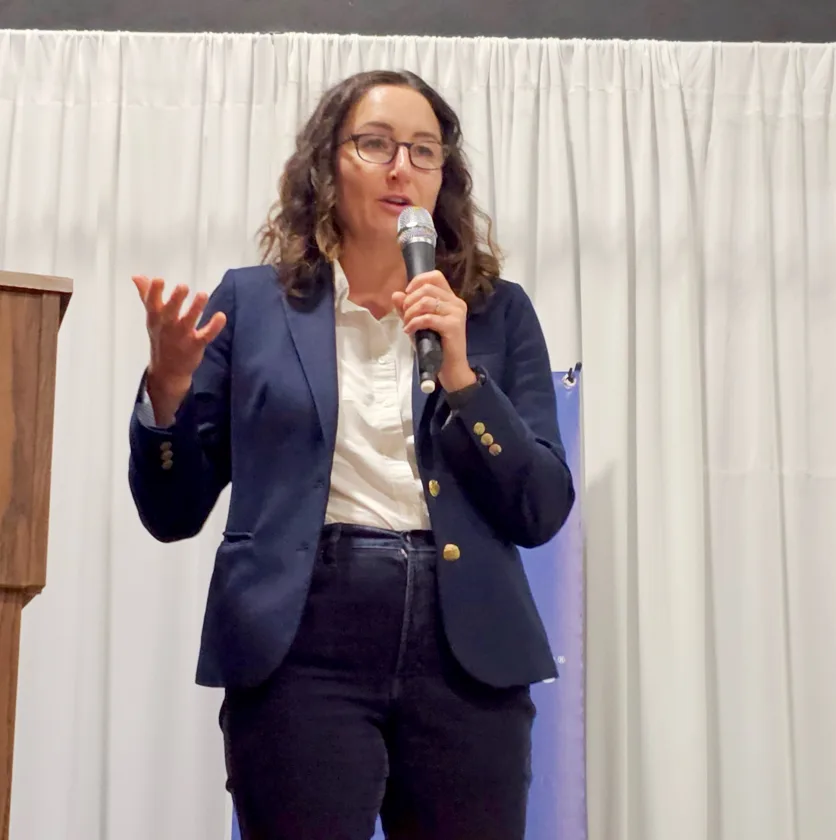
Melanie Hazelip speaks on election integrity and voting access during the League of Women Voters and Turner Hall "Voter 101" forum on Wednesday. (Photo by Amy Zents)
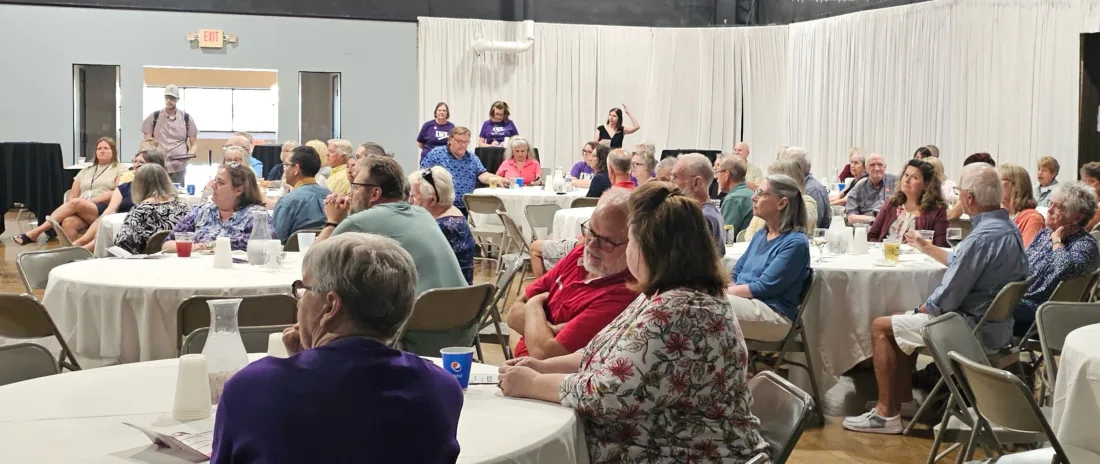
Community members gather at Turner Hall on Wednesday, for the "Voter 101" presentation co-hosted by Turner Talks, the League of Women Voters of New Ulm, and the New Ulm Public Library. (Photo by Amy Zents)
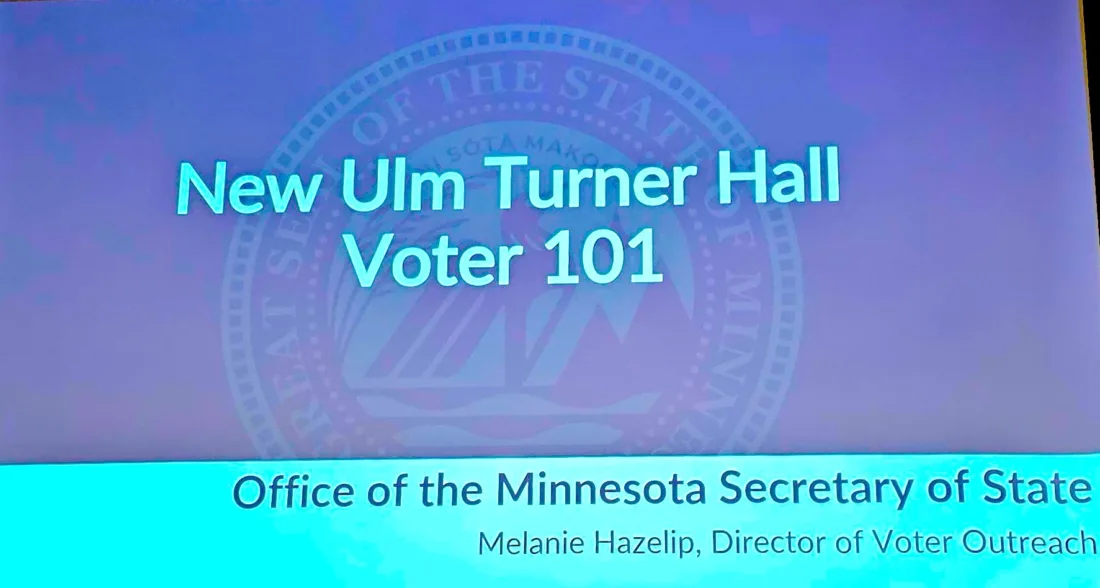
Melanie Hazelip speaks on election integrity and voting access during the League of Women Voters and Turner Hall "Voter 101" forum on Wednesday. (Photo by Amy Zents)
Community members gather at Turner Hall on Wednesday, for the "Voter 101" presentation co-hosted by Turner Talks, the League of Women Voters of New Ulm, and the New Ulm Public Library. (Photo by Amy Zents)
Trending
NEW ULM -- Melanie Hazelip, Voter Outreach Director for the Office of the Minnesota Secretary of State, delivered a clear, practical "Voter 101" presentation Wednesday evening at Turner Hall, walking the audience through eligibility rules, registration, early voting options, and the multiple layers of security built into Minnesota elections.
The forum was hosted as part of the ongoing Turner Talks series in partnership with the League of Women Voters of New Ulm and the New Ulm Public Library.
Andrea Boettger, executive director of New Ulm Turner Hall, provided opening remarks, introducing the forum and the educational objectives of the nonpartisan talk series.
Dan Hoisington, local historian and Turner Hall board president, followed with remarks on the local significance of civic engagement.
“The reason this building is here in New Ulm ultimately goes back to voting rights,” Hoisington said.
He explained how German immigrants fled political disruption in the 1850s to build a community centered on democracy, education, and enlightenment.
“Years ago, a group of German immigrants said, ‘We need to protect the right to vote and we need to build community.'”
Chloe Dickson, adult programming librarian at the New Ulm Public Library, emphasized the library’s role as a nonpartisan partner in supporting an informed electorate.
“The reason why the library is here and I am representing us is because we are big advocates of democracy,” Dickson said. “We seek to give you all this knowledge and information that you seek.”
Theresa Keaveny, a representative of the League of Women Voters, outlined the organization's dedication to nonpartisan voter education. Keaveny specifically directed voters to Vote411.org to view sample ballots, review candidate profiles, and learn about the local races on their respective ballots.
Featured speaker Hazelip, who has worked in voter engagement since 2016 and has been with the Secretary of State's office for the past four years, said her goal is simple, she works to ensure “eligible Minnesotans know how to access voting, and she works to cut through the confusion and misinformation that surrounds elections."
“Minnesota has a lot of great laws on the books that make voting both accessible and secure,” Hazelip said.
She said that the primary reason Minnesota maintains its position as an election performance leader is because “we really do a lot of things right.”
The state ranks No. 1 on the most recent MIT election performance index for election administration and accuracy, a ranking she credited largely to local election officials and election judges.
Hazelip detailed that while about a quarter of Minnesotans utilize mail-in ballots, up to 35% still cast their ballots in person on Election Day. She emphasized that all mail-in ballots are subject to standard verification security procedures.
“Voting by mail is as secure as in-person voting, if not more secure,” Hazelip stated. “If you don’t trust the system, if you don’t trust the county or maybe the federal government or even the state government, hopefully, you trust your county officials, because they’re the ones that are securing your ballots.”
She reviewed the basic eligibility requirements: U.S. citizenship, age 18 (with pre-registration available at 16 and 17 so the registration activates automatically on the 18th birthday,) Minnesota residency of at least 20 days, and not currently incarcerated for a felony offense.
A 2023 law restored voting rights to people on probation or parole for felony convictions. That single change added approximately 55,000 newly eligible voters, the largest expansion of voting rights from one bill since the late 1970s, when the voting age was lowered from 21 to 18. Voters under guardianship almost always retain the right to vote unless a judge has specifically revoked it.
Registration can be completed online or by paper application at MNVotes.gov. Forms and materials are available in multiple languages.
Every registration is entered by a county official into the Statewide Voter Registration System and is verified daily against databases from the Minnesota Department of Health (death records), the Social Security Administration, the Department of Corrections, Driver and Vehicle Services, and the U.S. Postal Service.
Hazelip outlined Minnesota's three ways to vote and the calendar for 2026. Early voting for the Aug. 11 primary began June 26, with the new "Early Voting" (direct balloting) process starting July 24. Early voting for the Nov. 3 general election begins Sept. 19.
Voters can also request an absentee ballot by mail and track its status online at mnvotes.gov/track, similar to tracking a package. Ballots themselves are not counted until polls close on Election Day.
She strongly encouraged people to use the "What's on My Ballot" tool at MNVotes.gov. Entering an address produces an exact sample ballot, confirms registration status, and shows the correct polling place. The tool is especially useful in a year with many races on the ballot, she said.
On the question of why voting matters, Hazelip listed several reasons: it is how people impact the policy issues that affect daily life, stand up for their beliefs, claim their power, engage in democracy, and set an example for children.
She said that every year in Minnesota at least one race is decided by a single vote or a tie.
Turning to election security, Hazelip walked through the process before, during and after Election Day. Before the election, public accuracy tests of every tabulation machine are required in all 87 counties and are open to public observation. Absentee ballots are checked for tampering, matching identification numbers, and matching signatures, usually by two officials. Once accepted, ballots are securely stored.
On Election Day, processes are handled with bipartisan election judges, and vote totals are not released until polls close. After the election, results are not official until certified by the state canvassing board, which includes the secretary of state, two members of the Minnesota Supreme Court, and two district court judges.
Every county also conducts a post-election review in which one randomly selected precinct's ballots are hand-counted to verify the machine totals.
Addressing concerns about non-citizen voting, Hazelip said registration data are cross-checked against the Social Security Administration.
Non-citizens who hold only a tax identification number do not match the citizen classification required in the system. Every voter must also sign an oath under penalty of perjury. Penalties include up to 10 years in prison, fines, and, for non-citizens, permanent deportation.
A University of St. Thomas analysis of more than 13 million ballots cast over a 10-year period found only three convictions for non-citizen voting.
Hazelip closed by urging residents to serve as election judges. The state needs roughly 30,000 workers for each statewide election.
Sixteen- and 17-year-olds can serve as trainees. She said that serving is a practical way for skeptical citizens to see the process firsthand.
"You don't have to take it from me or the Secretary of State's office or even your county auditor," she said. "You can go see for yourself."
Early voting for the Aug. 11 primary is already under way.
Additional information, sample ballots, registration tools, and a fact-versus-fiction page are available at MNVotes.gov.
Hazelip invited follow-up questions by email at melanie.hazelip@state.mn.us or by phone at 612-327-1621.