
Rock, Roll, and Ink
The Minneapolis Labor Temple story
Trending
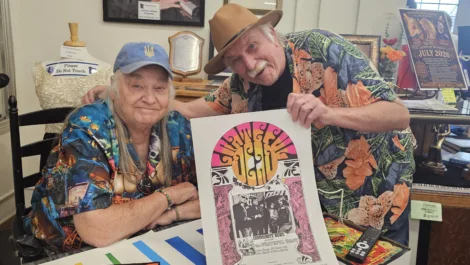
NEW ULM -- Poster artist George Ostroushko shared original artwork and historical accounts from the 1969-1970 Minneapolis Labor Temple rock concerts during a Saturday morning presentation at the Minnesota Music Hall of Fame.
Ostroushko brought original concert posters, second editions, and copies of his book, Cosmic Trip: Rock Concerts at the Minneapolis Labor Temple 1969-1970. The book documents the promotional artwork he designed for the short-lived music venue located on the third floor of a labor union building at Fourth Avenue and Central Avenue in Minneapolis.
Born Juryj in Austria, Ostroushko received the name George at Ellis Island upon his family's arrival in the United States.
After leaving a vocational high school in Minneapolis in 1967, he traveled to San Francisco during the Summer of Love to pursue music.
While living out west, he learned poster design from artists Stanley Mouse and Alton Kelley at Mouse and Kelley studio. He stayed in a residence with members of the Grateful Dead, including lead guitarist Jerry Garcia and keyboardist Ron "Pigpen" McKernan, and spent time with guitarist Carlos Santana before returning to Minnesota.
Upon returning home, Ostroushko partnered with light-show creator Charlie Campbell of the Community News Light Show and local promoter David Anthony to stage rock performances.
The organizers previously hosted local bands at Dania Hall, an historic Swedish community center on the West Bank featuring a Victorian balcony and a strict 500-person capacity limit.
Seeking a larger facility capable of hosting national touring acts, Anthony secured a lease for the third floor of the Minneapolis Labor Temple, situated near the University of Minnesota campus across from a regional White Castle landmark.
The Labor Temple held its inaugural concert on Feb. 2, 1969, featuring the Grateful Dead, with tickets priced at $3.50.
Although municipal regulations required fixed seating and restricted attendance to approximately 1,250 people, organizers disregarded the rule to replicate the open dance floor of San Francisco's Fillmore Auditorium, selling more than 2,600 tickets.
During the performance, organizers dropped joints from the ceiling structure, and the band played past 1 a.m., exceeding the city’s midnight residential curfew.
Municipal authorities issued fines to organizers the following morning.
Approximately 500 posters were printed for the premiere performance, and an original copy later sold at auction for $22,000.
The venue quickly became a primary Midwest weekend stop for touring acts traveling between Chicago, Detroit, and San Francisco.
Subsequent performers included Jethro Tull, who played their second American appearance at the hall for a $600 fee, and the Allman Brothers Band, who made their first concert appearance north of the Mason-Dixon Line on Feb. 1, 1970.
Guitarist Jeff Beck performed alongside vocalist Rod Stewart and bassist Ronnie Wood, during which equipment malfunctions led Stewart to toss a microphone across the stage before leaving.
Other featured acts over the two-year span included Muddy Waters, Canned Heat, Country Joe and the Fish, the Byrds, Procol Harum, Johnny Winter, Spirit, Mother Earth, Alice Cooper, the Velvet Underground--who traveled with manager Andy Warhol, the Buddy Miles Express, Savoy Brown, the Youngbloods, the Faces, MC5, and Grand Funk Railroad.
Regional Twin Cities bands, including the Litter, Joker's Wild, and Zarathustra, frequently served as opening acts for national headliners.
Ostroushko designed most of the weekly promotional posters under short deadlines, receiving $125 per design.
To maintain control over production, he and partner Jim Parsons established Pig Puppy Press, operating a two-color Heidelberg printing press in a Minneapolis basement. The pressmen utilized split-fountain ink techniques to produce multi-color rainbow effects, despite the risk of damaging the machinery.
Between 500 and 700 copies were printed weekly and distributed across telephone poles and store windows throughout the Twin Cities, where fans frequently removed them.
Ostroushko preserved his original sketches, plates, and posters in storage portfolios for decades.
Local musicians Kevin Odegard and Craig Odegard, along with regional auctioneer Paul Pash, eventually encouraged him to organize the materials into a book documenting the venue’s historical significance. Ostroushko self-published an initial run of 1,000 four-color copies, which sold out within six months.
The University of Minnesota Press subsequently acquired the title for national distribution. During his presentation, Ostroushko emphasized that the venue’s creators viewed themselves primarily as music historians capturing a cultural movement rather than traditional visual artists.
The third-floor hall lacked air conditioning, alcohol, and food concessions, requiring seasonal closures during humid summer months before shutting down permanently after two years.
Ostroushko's late brother, multi-instrumentalist Peter Ostroushko, worked as a 15-year-old ticket taker at the hall prior to launching his own professional music career, which later earned him Emmy Awards and national acclaim.
Minnesota Music Hall of Fame board member Neal Bond organized the New Ulm appearance and produced an introductory multimedia video presentation titled Posters, Promoters, and Lights.
The Minnesota Music Hall of Fame educational series continues with regional music historian Jeanne Andersen, who will deliver a virtual presentation on Saturday at 11 a.m. Andersen specializes in documenting Minnesota's 1960s rock, pop, and ballroom music scenes, including venues such as the historic Marigold Ballroom in Minneapolis.
General admission for the event is $7, while annual memberships cost $30 and include virtual access to present and future hall of fame presentations.