
Growing the Ivy House model of day care
New licensure could expand childcare options
Trending
NEW ULM - For nine years, Ivy House has served the New Ulm area as a 24/7 crisis nursery, providing childcare for children 0-10 years of age for up to 72 hours.
Since Ivy House was founded, the need for emergency childcare has increased in the community. In June, Ivy House received 142 calls for childcare services. This is the highest monthly record since the crisis nursery was founded. In July, the calls for service reach over 80, but this is still above average.
With the demand for the service rising, Ivy House recently moved the operation new a new home to offer a larger space of kids, but is also working with state legislators to make it easier for other communities to copy their model.
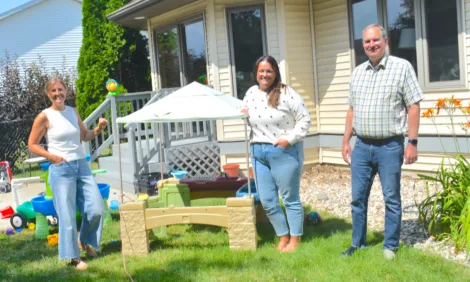
Ivy House Board member Anna Friese said they moved out of the previous house on 5th North Street back in May to the new location.
Friese said the previous house had limited space for the kids and staff. It led to a bottleneck in some of the rooms and there was less space inside the house for kids to run around and use motor-skills. The new house has a large finished basement and backyard space.
Ivy House Executive Director Kari Williams said the new house also gives extra room for kids who need space to destress. Often, the kids staying at Ivy House are coming from stressful situations.
Williams clarified that Ivy House is designed to help families in any kind of stressful situation.
Technically, Ivy House is called a crisis nursery, and it is available to families experiencing crisis, but it is also available to smaller unique situations.
"I think people hear crisis nursery or emergency day care and think big traumatic things, but that's not necessarily what we serve," Williams said. "We try to serve any level of stressful situation for families and be a safe haven for kids."
This could mean any situation where childcare is causing stress in a home, or any hardship. This could be a situation where a parent needs to return to work and no longer has time off. Ivy House has stepped in when regular day care was unavailable.
Fries said they have watched a child whose mother had to return to the hospital after complications from giving birth.
"If it’s causing stress in the home, that's our biggest indicator," Williams said. "We want to be there to help."
In nine year, Ivy House has helped many families in an emergency and the demand for their services seems to be on the rise.
Williams believes the increase in service is likely due to greater awareness. Word has gotten out about Ivy House and its unique status. While there are other crisis nurseries in Minnesota, none are built in a home setting. Most are facility-based or operate similarly to a foster home. Others are restrictive on which families can use them.
Ivy House will take in kids from a two-hour radius of New Ulm, which means some families from the metro area have used it.
With the demand for day care services high all over Minnesota, the question becomes, why are other communities not copying the Ivy House model?
Ivy House Board Chairman John Blomberg said it all comes down to licensure. Ivy House currently operates with two day care licenses.
"We have a shelter license and a day care license," he said. "It's very clunky."
With two licenses, Ivy House staff are required to fill out twice the paperwork of the typical day care.
Friese said a traditional day care will see the same kids every day for years. That day care will naturally have documentation, including vaccine records or other medical information on those kids. Ivy House is required to have the same amount of paperwork on each, even if they only see that child once for a few hours. The same problem exists for the shelter license.
"It's cumbersome," Friese said.
The extra paperwork also applies to Ivy House staff. For each person on the staff, paperwork must be filled out in duplicate. It creates a lot of unnecessary redundancy.
That's a lot of work and many on the Ivy House board felt it should be easier, but not just for them, but also for others.
"We want it to be easier for other places like this to open," Fries said. "We've been working with the state for a couple of years to get the right fit for licenses for us."
The effort has paid off. Williams confirmed that in the last legislative sessions, a bipartisan coalition of legislators from across Minnesota advanced and passed a crisis nursery licensure reform. This legislation removes unnecessary barriers to licensure while maintaining strong standards to protect children and families, making it easier for communities across the state to establish crisis nurseries and expand access to critical support for parents and caregivers during times of crisis.
The licensure is expected to go into effect in January 2028. This means Ivy House will need to operate under the two-license system for another year and a half, but now there is a light at the end of the tunnel and hope for statewide expansion.
"With new licensure in place and us putting enough pieces of the puzzle together, this model could be used in other cities in the area," Blomberg said.
Friese said they have already been contacted by other communities looking to adapt the Ivy House model.
There are currently 14 staff members working at Ivy House, but Williams said they are always looking for more people willing to work. She said anyone with a background in early childhood education; work in a group home, or works as a para professional at the school would be an idea candidate.
Williams said Ivy House is a great supplemental employment option for people who are already employed. Since Ivy House operates 24/7, there are plenty of extra shifts available for those interested.
For more information on Ivy House, visit their website at https://ivyhousemn.org/