
Adapting with the times
Therapist Greg Omori retires after a 50 year career
Trending
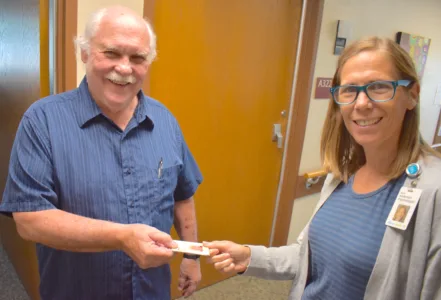
NEW ULM - For the last 22 years, Greg Omori has worked in New Ulm Medical Center's (NUMC) Outpatient Mental Health Department as a Licensed Independent Clinical Social Worker (LICSW).
Just under two weeks ago, Omori officially retired, but not before giving one final interview to The Journal about his five decade career working in mental health.
Omori is originally from Chicago. He grew up a block and a half from Lake Michigan. He attended the University of Dubuque, Iowa, where he met his wife, Karen, who was attending college for social work. Omori credits his wife for getting him into the field of social work and mental health.
Initially, he was attending college as a business and accounting major, but then one day, he took a look at Karen's textbooks and realized he could have a career in talking to people.
"I love talking to people," he said. "I switched majors the next day. In fact, I got so into it that I triple majored. Social work, psychology and sociology major."
Omori ultimately earned his graduate degree from the University of Iowa in social work. After graduating, he immediately went into residential treatment. In the beginning, he worked with youth clients and would continue to work with young people through his five decade career. He said in his time working for NUMC, about half his cases were youth clients.
Omori said that once he started residential treatment work and realized how much children needed attention and help, he was completely won over by them and never looked back.
"When you establish a relationship with them and they feel they can trust you, change can happen," he said. "I think a lot of times kids are not sure who to trust and once they know you are there to help them, and this is a safe place to talk, they can be very helpful."
During his career, Omori worked for several clinics. In 1994, he moved to New Ulm and began working for Sioux Trails Mental Health and was again working with children. He would later work for the Leo A. Hoffmann Center in St. Peter. In 2004, he came to NUMC and would work in their Mental Health Department for the remainder of his career.
Omori said one of the reasons he stayed at NUMC for 22 years was the variety of patients and casework. He also credited his fellow support staff at NUMC.
"I wouldn't have stayed this long without an excellent support staff," he said. "It makes it enjoyable when you know you can count on people."
Omori said a lot has changed in mental health in five decades. There were many conditions that were not readily understood until later.
Omori said during his initial work with children, his focus was on treating anger. Many of the young clients he saw were dealing with anger issues.
"As the years went past, I started understanding that I was missing trauma issues," he said. "There was a reason for the behaviors."
The trauma was always there, but mental health professionals did not recognize it until recently.
"And that's going to continue into other areas," Omori said.
The study of mental health is never really done. Omori is confident that people working in mental health professions will continue to identify knew avenues of treatment and identify things that were overlooked.
Omori said recently that there has been a push to teach new techniques for handling stress. He said many of these were taught to adults for years, but now mental health professionals are finding children respond to the techniques as well.
"What surprises me most is some of my youth clients, after learning the stress reduction techniques and turning around, teaching them to their family members," he said. "That's great, because if you can teach someone else the technique, you've mastered it."
Omori said another trend he is seeing within the last five years is an increase in anxiety. It is something he has seen in all age groups. He said sometimes anxiety might be misdiagnosed as depression, when in reality, depression is a symptom of anxiety.
"Anxiety can wear you down and lead to depression," he said.
While there are different techniques for treating anxiety, Omori said there is no one-size-fits-all approach. Every patient requires an individual approach.
"When a new patient comes in, I let them choose the direction we go," he said. "I ask them what they want to talk about and I try to meet them where they are, adapt to the patient, let them choose their pace. Never force it."
Omori said he learned a lot from working with patients. Each person he met with helped him to become better at his job to help the next person.
Omori said it was his senior patients who helped him decide it was time to retire. Many of his patients were preparing to retire, but found their plans needed to change because they could no longer physically do what they planned.
Omori decided he wanted to retire while he was physically able to make new plans. That said, he is unsure what he will do with his retirement.
"I tell myself the same thing I tell my patients, 'Take it one day at a time,'" he said. "I'll take it one day at a time and figure it out from there."
Omori remains optimistic about the future of mental health. He is optimistic that professionals will continue to make breakthroughs in the treatment of anxiety and trauma and different ways to treat individual needs.
He is happy to see that the stigma around mental health has diminished since his career began. There were times in his early career when individuals would never consider seeking treatment, but that has changed significantly.
"I do think that people are more accepting of treatment," he said.