
Dog trials draws owners from near, far
St. Paul's Lutheran School hosts four-day event
Trending
NEW ULM -- Four days of AKC (American Kennel Club) Scent Work Trials drew participants from throughout the Midwest to St. Paul's Lutheran School July 23-26.
The multi-day scent work trials featured novice, advanced and buried container searches.
Dogs are trained to recognize specific odors.
In the Container Novice division, ten identical cardboard boxes are arranged in two rows of five containers. Dogs must indicate an odor in one box to its handler within two minutes. As the dog and handler advance to higher levels, there are more containers and hides.
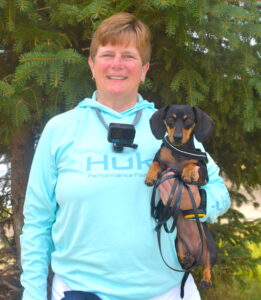
Dog owners participating included Theresa McNamara of New Ulm and "Rosie," her black and tan miniature dachshund.
"I've had the dog for six years. I got her when she was eight weeks old," McNamara said. "On Friday, were took part in the detective, the highest level and took first and fourth place."
She talked about what she enjoys about scent work trials.
"I just love meeting all the people in it," said McNamara. "This is a performance sport, as opposed to dog competition sport. I love having constructive things to do with my dog and improving our relationship."
Dogs are evaluated on their natural instincts, training, and ability to perform tasks.
She described how the upper levels of scent work trials are done.
"Two drops of essential oils are placed on a Q-tip that is placed under two inches of sand in a container," said McNamara. "There are 16 containers, eight of which have sand in them and eight have water in them. Q-tips are dropped in the water. You have a certain amount of time, depending on the competition level, to determine which boxes have sand and which have water in them."
McNamara was very thankful for St. Paul's accommodating the trials.
"Usually, the closest trails are in the Twin Cities. I often go to trials and training there," she said. "Sometimes there are 100 teams (dogs and handlers) on a wait list for competition."
Other trials include hunting, pointing and retrieving field trials and sheepdog (herding) trials.
Dogs often run in pairs released onto a course to locate game birds like quail, pheasants or partridges.
A pointing dog must find the bird and lock into a rigid "point." A flushing or retrieving dog must flush the bird, sit steady while a hunter shoots, then retrieve the downed bird efficiently without damaging it.
Judges evaluate how well the dog covers ground, its response to whistle/voice commands, and it's steadiness.
Herding trials evaluate a dog's ability to manage livestock in a calm, controlled manner.
Handlers stand at a designated post while the dog is sent hundreds of yards away to find the sheep.
The must must "outrun" (circle) the sheep, "life" (gently encourage) them toward the handler, and guide them through an obstacle course that usually includes narrow gates, a bridge, and a sorting pen.
Points are deducted for sheep that run away, miss obstacles, or if the dog panics.
Timed, high-energy obstacle courses test the bond and communication between dogs and handlers. Courses contain jumps, tunnels, weave poles and see-saws.
Handlers walk the course off-leash to memorize it, then guide their dog through the obstacles in the exact sequence without faulting or going over a time limit.
The trials were sponsored by the Key City Kennel Club, Inc. of Mankato, a non-profit organization that instructs people with dogs of all breeds, mixes, sizes and ages to train their dogs to be good companions.