
‘We need all the farmers we have’
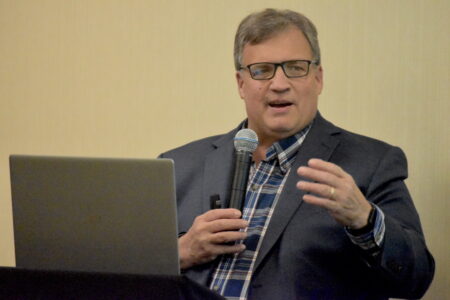
Thom Petersen speaks at CGMC Summer Conference in NU
Trending
NEW ULM -- Minnesota Agriculture Commissioner Thom Petersen talked about agriculture opportunities and challenges in detail at the Coalition of Greater Minnesota Cities (CGMC) Summer Conference at the New Ulm Convention Center Wednesday.
"We need all the farmers we have," said Petersen. "We have 64,000 farms in Minnesota but we lost 1,300 farms the last two years. That's been hard. The ag economy has really been struggling. Lots of people are retiring too."
He said 500 state farm mediation notices were sent out in June and July of 2025. This year, 150 were sent out in May and 82 in June.
University of Minnesota Mandatory Farmer-Lender Mediation uses a trained, neutral facilitator to assist in the negotiations of parties in a dispute. Mediation is an informal and confidential process that generally requires less cost and time than adversarial court litigation.
Petersen said Minnesota led the nation in farm bankruptcies during the first quarter of 2026.
Farmer suicide rates are estimated at 3.5 times greater than the general population, according to the Minnesota Department of Agriculture (MDA).
"We're hearing increasing reports of farmers in stress who have taken or may be thinking of taking their own lives. We're all concerned about them," Petersen said earlier this year.
He said Minnesota is No. 1 in the U.S. in sugar beets and turkey production, second in sweet corn and hogs, fourth in soybeans and corn production, fifth in ethanol production and sixth in cheese and rye production.
He said there are more than 400 farmer's markets in Minnesota, many of which have grown "incredibly" the last few years.
Petersen said Minnesota balances crops and livestock production pretty closely, more so than many other states.
He said the MDA offers grants and loans for cover crops and reduce tillage practices.
"Soil Health Financial Assistance Grants provide cost-share for the purchase and retrofit of soil health equipment. A new grant round opens in August," said Petersen. "The AgBMP Loan Program provides low-interest loans to farmers, rural landowners, and ag supply businesses to encourage ag Best Management Practices that prevent or reduce runoff from feedlots, farm fields, and other pollution problems identified by counties in local water plans."
He said beginning farmer opportunities include Rural Finance Authority loans, tax credits, down payment assistance grants, equipment and infrastructure grants.
"There is profitability in the cattle industry," said Petersen. "There is an increased interest and investment in local meat processing and processing education. It it taught at Ridgewater and Minnesota West Colleges now. It's interesting to know that more than half the students in those programs are from other states."
He said a strong network of active livestock auction markets continue to operate across the state.
"The demand for Minnesota's top exports is growing rapidly in Southeast Asia and Northern Africa," he said. "A thriving sustainable aviation fuel (SAF) industry can support farmers and foresters, create jobs and strengthen our rural economy. The SAF Hub is helping Minnesota lead the way by pulling together partners including Delta, Ecolab, Bank of America, Xcel Energy and the Minnesota Corn Grower's Association."
The Moorhead mayor thanked Petersen for his assistance in helping Moorhead land $5 billion for a sustainable jet fuel plant designed to create 650 jobs. The facility will convert ag and timber waste into jet fuel.
Agriculture mental health, stress, financial resources, and other information is available at www.mnfarmstress.com.