
Author details James Younger Gang’s time in Brown County
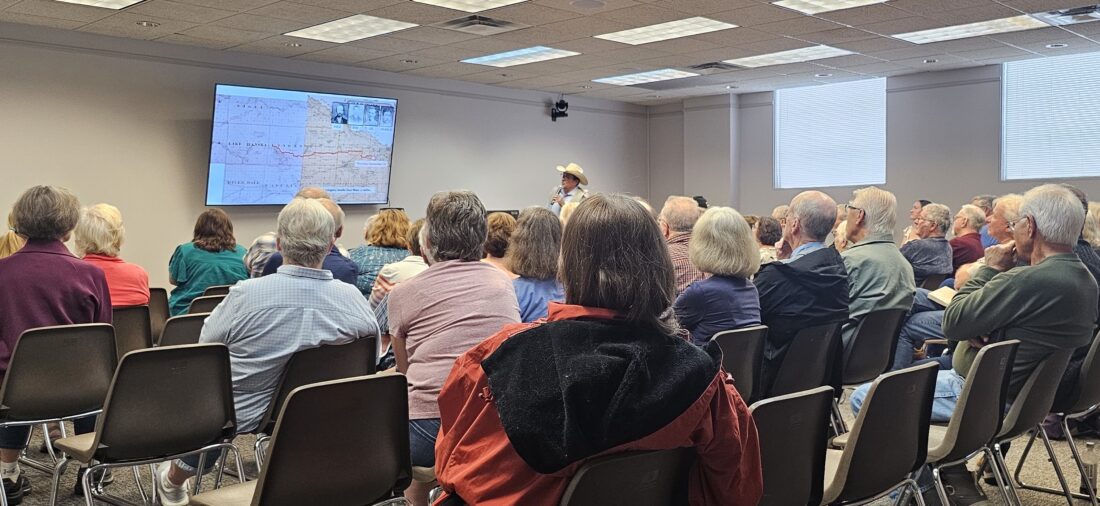
Audience members listen to Russ Swanson’s presentation on the James Younger Gang at the Brown County Historical Society. Photo by Amy Zents
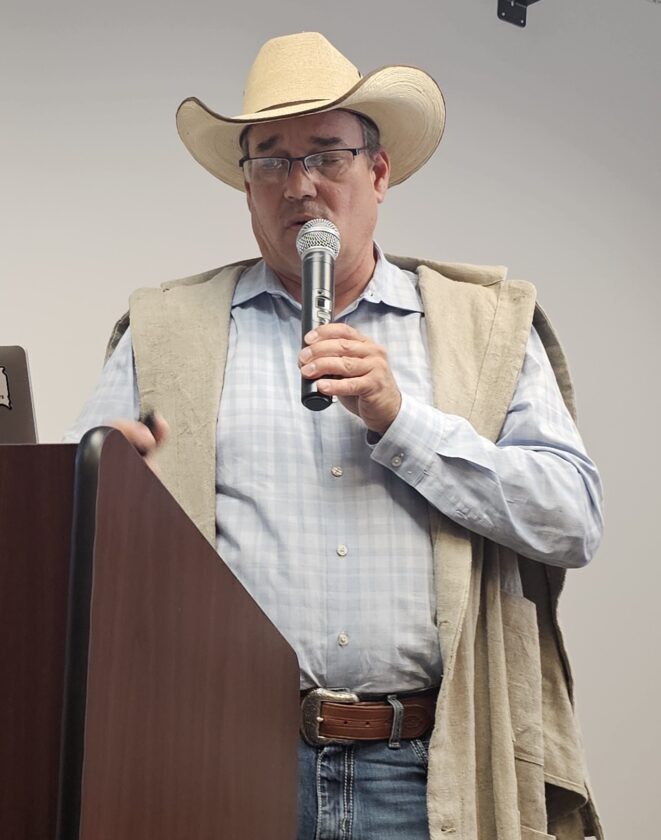
Russ Swanson presents at the Brown County Historical Society on the James Younger Gang’s involvement in Brown County. Amy Zents
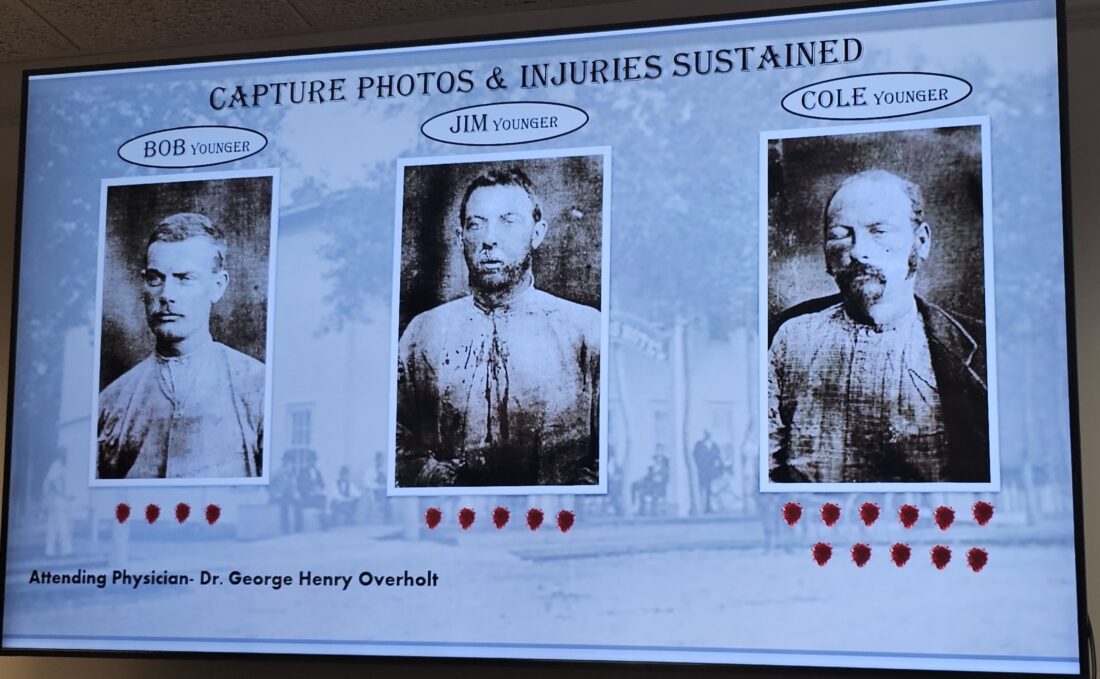
Capture photos of the Younger brothers displayed during Russ Swanson’s presentation, showing the injuries they sustained during their 1876 capture near Madelia. Bob Younger (left), Jim Younger (center) and Cole Younger (right). Attending physician was Dr. George Henry Overholt.
Audience members listen to Russ Swanson’s presentation on the James Younger Gang at the Brown County Historical Society. Photo by Amy Zents
Russ Swanson presents at the Brown County Historical Society on the James Younger Gang’s involvement in Brown County. Amy Zents
Capture photos of the Younger brothers displayed during Russ Swanson’s presentation, showing the injuries they sustained during their 1876 capture near Madelia. Bob Younger (left), Jim Younger (center) and Cole Younger (right). Attending physician was Dr. George Henry Overholt.
Trending
NEW ULM -- South Dakota educator and author Russ Swanson delivered a detailed presentation on the James Younger Gang escape route through southern Minnesota at the Brown County Historical Society.
The talk marked the 150th anniversary of the Northfield Raid. Swanson, who teaches agricultural education, civil engineering and architecture in Canton, South Dakota, based his remarks on years of research for his book "A Chase to the Death: The Detailed Pursuit of the James Younger Gang Following the Northfield Raid."
Swanson traced his interest to his family homestead south of Sioux Falls. "I was out doing some fencing in one of my horse pastures and I found these two depressions in the ground," he said. Records showed the site linked to neighbor Peter Wall, whose horse was stolen at gunpoint by Frank and Jesse James on September 19, 1876. "That hooked me into the story."
He stressed the use of primary sources. "You want to start with a credible source," Swanson said, highlighting J.H. Hansen's book "The Northfield Tragedy," written by a posse member and reporter. "It is almost like you were there, and that was kind of the premise for my book."
The gang of eight: Frank and Jesse James, Cole, Jim and Bob Younger, Charlie Pitts (alias Sam Wells), Clell Miller and Bill Chadwell, reached Minnesota in late August 1876 after robbing a train in Otterville, Missouri. They traveled by rail in small groups. "These guys were smart," Swanson said. "They were not all going to travel in one big group."
Their original target was Mankato. "A lot of people do not realize that," Swanson said. Recognition of Jesse forced a shift to Northfield. On September 7 the raid lasted seven minutes. "They got twenty-six dollars and seventy cents worth of nickels," Swanson said. "Not a good trade."
Citizens responded swiftly. Hardware store owners J.S. Allen and A.R. Manning, along with medical student Henry Wheeler, engaged the gang. "Get your guns boys they are robbing the bank," Allen shouted. Clell Miller and Bill Chadwell were killed. Bob Younger's elbow was shattered. Joseph Lee Heywood was killed inside the bank and Nicholas Gustafson died later.
Heavy rains followed. "It started to rain that night and it rained for the next two weeks," Swanson said. "This became one of the wettest times in Minnesota history." The gang abandoned horses and moved on foot through the Big Woods.
Near Mankato they crossed the Blue Earth River railroad bridge. "It was described that night as Egyptian darkness," Swanson said. He calculated the lunar position showed about 0.68 percent illumination, less than one percent.
Cole Younger and Charlie Pitts had scouted Madelia earlier, staying at the Flanders Hotel. "This was actually the thing that doomed them," Swanson said. They had spoken with owner Colonel Thomas Vogt about local geography and horses.
After splitting from Frank and Jesse near Jones Ford, the Youngers and Pitts moved slowly. On September 21, 17-year-old Oscar Sorbel spotted them near his family farm north of Linden Lake. "Dad, I think those are the robbers," Sorbel told his father, noting worn boot soles and suspicious behavior. Sorbel alerted neighbors and rode to Madelia.
Swanson highlighted the massive scale of the manhunt, which involved nearly 1,000 posse members coordinated across southern Minnesota by General John Pope.
Despite this overwhelming force, it was a small group of seven local men, known as the Madelia Seven who ultimately captured the Younger brothers and Charlie Pitts.
The group, led by Sheriff James Glispin and including Colonel Thomas Vogt and Dr. E.W. Overholt, cornered the fugitives near the Watonwan River after 17-year-old Oscar Sorbel raised the alarm.
Their determined pursuit and gunfight ended the manhunt for four of the gang members just two weeks after the Northfield Raid.
The outlaws headed for horses at the John Doolittle farm but were intercepted. "We were in sight of our long sought horses when they cut us off from the animals, and our last hope was gone," Cole Younger later recalled.
Charlie Pitts was killed. The Youngers, heavily wounded, Cole with 11 bullets, Jim with five, Bob with additional shots, surrendered. "Pitts, if you want to go out and surrender, go on," Cole said. Pitts replied, "I will not go. I can die as well as you can."
The captives were taken to the Flanders Hotel in Madelia. While there, Bob Younger looked out a window and saw the gray Percherons that Frank and Jesse James had ridden earlier in their escape. "You see, I am as curious as the rest of you," Bob Younger remarked.
Frank and Jesse continued southwest. They stole horses including gray Percherons near Garden City and blind mares near the Big Sioux River. Documented stops included the Rolfe farm north of Luverne and the Nelson farm near Brandon. At the Peter Wall site near Canton, South Dakota, they stole horses at gunpoint. "Hey, we are looking for horse thieves. Can you help us out?" they told Wall and others.
The James brothers escaped through Iowa. The Youngers were convicted and sentenced to life at Stillwater Prison. Bob died in 1889. Jim died by suicide in 1902. Cole, aided by Horace Greeley Perry, the girl he had given a ride in St. Peter years earlier, received parole in 1901 and a full pardon later. He died in 1916.
Swanson demonstrated his meticulous mapping techniques during the presentation, combining historic township plats and land patent records with modern technology. Using the rectangular survey system, he located exact sites of houses and farms where the gang stopped or encountered residents.
He then overlaid 19th-century maps, including the 1874 Andreas map found on Bill Chadwell's body, onto Google Earth imagery. "You can literally get within several hundred yards of where these events actually occurred," Swanson said.
This approach allowed him to trace the gang's route through Brown County and surrounding areas with remarkable precision, showing how terrain, rivers and roads shaped their desperate flight. The visual overlays helped the audience understand how the fugitives slipped through large posses and navigated the landscape during one of Minnesota's wettest periods.
Audience member, Jeff Sieve of New Ulm, shared connections including an 1885 history volume noting a James brothers dinner stop three miles north of Concord.
Sieve's wife, Sue, described the talk as very good and very interesting with surprise at how close events occurred to New Ulm.
Swanson tailors each presentation to the area where he is speaking. "Every one's actually different because I try to gear it a little bit more to the area in which I'm speaking," he said.
The presentation showed how terrain, weather, citizen action and chance shaped the outcome in Brown County and beyond. Swanson's book is available on Amazon.