
Medieval meets contemporary at Cellar Press
Artist Ellis MacMillan completes residency at Grand
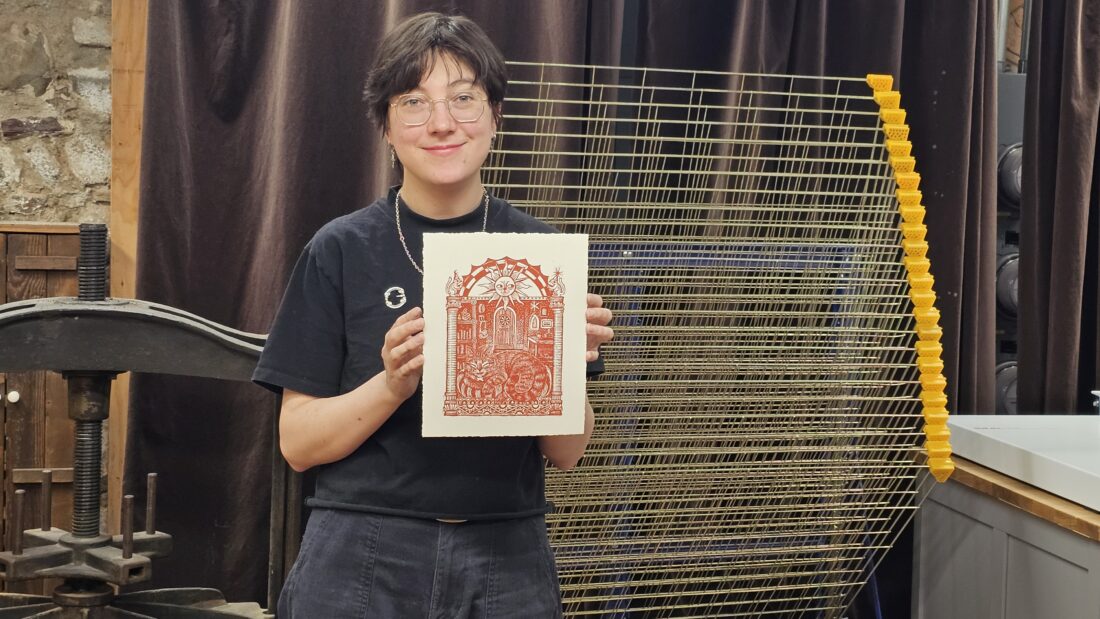
Artist‑in‑Residence Ellis MacMillan holds up a freshly pulled linocut print in the Cellar Press studio at The Grand Center for Arts & Culture. MacMillan’s work blends medieval imagery with contemporary printmaking techniques. (Photo by Amy Zents)
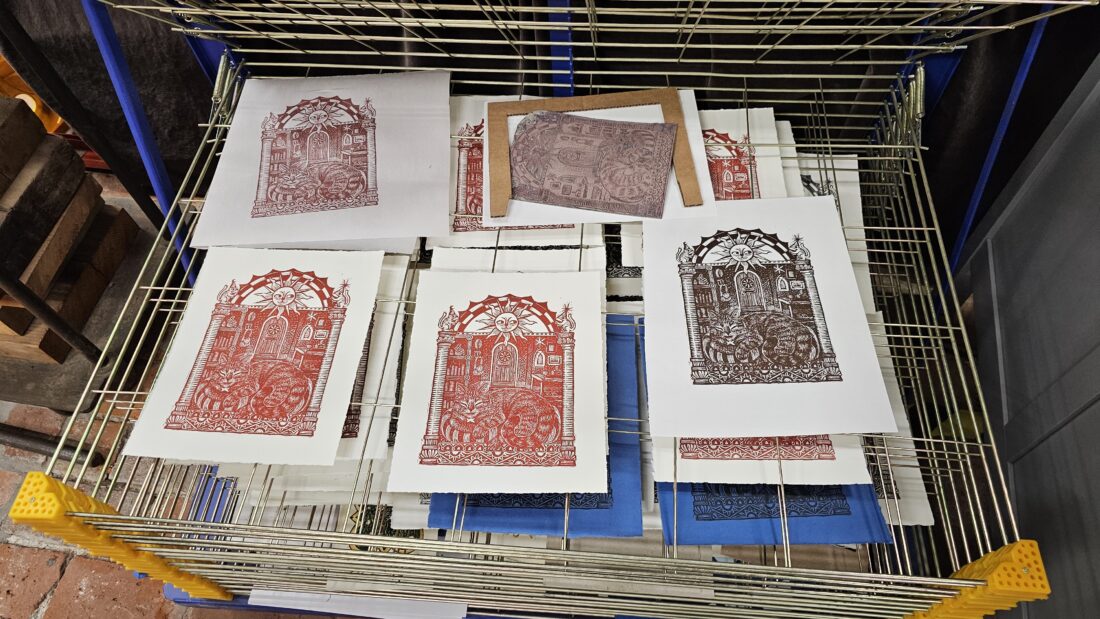
Linocut prints by Artist‑in‑Residence Ellis MacMillan dry on racks inside Cellar Press at The Grand Center for Arts & Culture. MacMillan’s residency focuses on small block prints inspired by medieval woodcuts, folklore, and local flora and fauna. (Photo by Amy Zents)
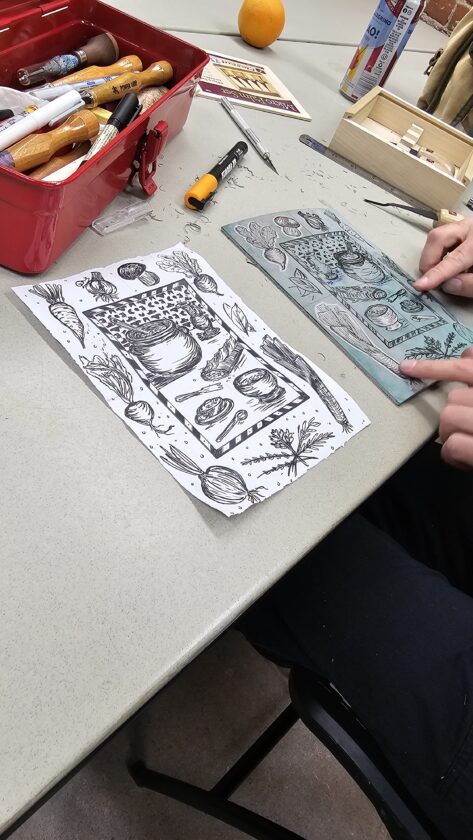
Artist‑in‑Residence Ellis MacMillan carves a linoleum block during their residency at Cellar Press. MacMillan’s process emphasizes natural texture, imperfection, and the tactile qualities of traditional printmaking. (Photo by Amy Zents)
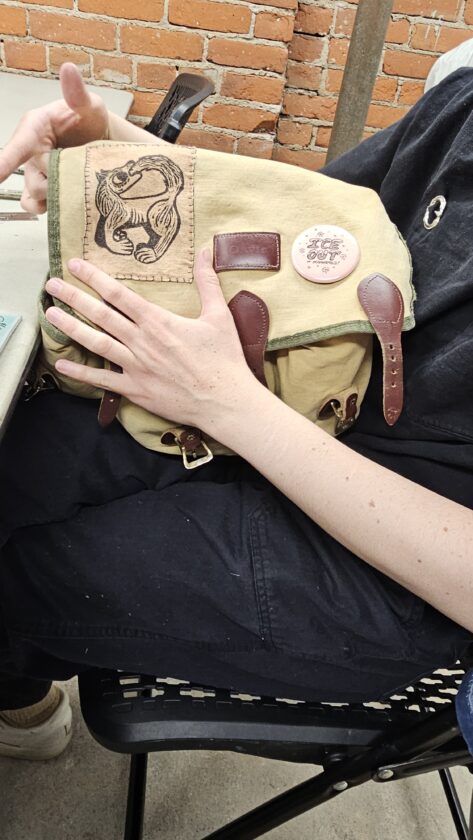
A canvas bag with MacMillan’s personal style and handmade accessories reflect the playful, illustrative qualities present in their printmaking. (Photo by Amy Zents)
Artist‑in‑Residence Ellis MacMillan holds up a freshly pulled linocut print in the Cellar Press studio at The Grand Center for Arts & Culture. MacMillan’s work blends medieval imagery with contemporary printmaking techniques. (Photo by Amy Zents)
Linocut prints by Artist‑in‑Residence Ellis MacMillan dry on racks inside Cellar Press at The Grand Center for Arts & Culture. MacMillan’s residency focuses on small block prints inspired by medieval woodcuts, folklore, and local flora and fauna. (Photo by Amy Zents)
Artist‑in‑Residence Ellis MacMillan carves a linoleum block during their residency at Cellar Press. MacMillan’s process emphasizes natural texture, imperfection, and the tactile qualities of traditional printmaking. (Photo by Amy Zents)
A canvas bag with MacMillan’s personal style and handmade accessories reflect the playful, illustrative qualities present in their printmaking. (Photo by Amy Zents)
Trending
NEW ULM -- Artist-in-residence Ellis MacMillan's work in the Grand's Cellar Press concludes Friday, March 27.
MacMillan has been working to produce a series of linoleum block prints that draw from medieval imagery, folklore and the natural world.
MacMillan, 30, is a Minneapolis-based printmaker who works primarily in relief printing and Risograph duplication.
The current residency focuses on creating five to 10 small linoleum block prints influenced by medieval woodcuts, local flora and fauna, and traditional storytelling imagery. Originally from Colorado, MacMillan grew up in a resort town with limited access to arts resources.
"There was maybe one bookstore," they said. "And it wasn't always open."
Early exposure to creative work came through family influences, included a father who produced handcrafted chain mail for Renaissance festivals.
"I think a lot of it came from playing knights as a kid," MacMillan said. "That, and just being around that kind of artwork growing up."
MacMillan moved to the Twin Cities in 2014 to attend Macalester College in St. Paul, where they studied art history after an intended focus on medieval studies was discontinued. Their academic work included classical art from ancient Greece and Rome.
Although formally trained in art history, MacMillan is largely self-taught in studio practice.
"I made some pretty bad prints when I started," MacMillan said. "But over time, you just get better."
MacMillan works in relief printing, which involves carving an image into a surface such as linoleum, with raised areas holding ink to produce the final print. The process is irreversible and requires precision.
"There's no undo button," they said. "Once you carve something away, it's gone."
They also uses Risograph printing, a duplicating process that layers colors through a machine similar to a copy printer, producing variations in alignment and texture.
MacMillan's work reflects historical influences, including the designs of William Morris and the engravings of Albrecht Dürer. These references appear in detailed compositions and repeated motifs drawn from medieval manuscripts and decorative traditions.
"A lot of fairy tales and folklore are basically horror stories," MacMillan said. "And medieval art is full of monsters and strange creatures."
Their work often combines these elements into visual narratives featuring animals, symbolic forms and scenes rooted in storytelling traditions. Even everyday subjects reflect that approach.
During the residency, MacMillan is developing a cohesive body of small-scale prints intended to reflect historical techniques and contemporary applications. The work emphasizes texture, line and pattern through manual processes.
"I hope people appreciate how tactile it is," they said. "There's not really any way to take shortcuts. It's very time-consuming, but very rewarding."
Now based in Minneapolis, MacMillan described the Twin Cities as a supportive environment for artists.
"I was surprised at how robust it is," MacMillan said. "People are very willing to help each other."
In addition to studio work, MacMillan has experienced teaching printmaking workshops and plans to return to Cellar Press this fall to lead a session on linoleum block printing on fabric.
"I want people to realize it's easier than you think to get started," they said. "If you're motivated, you can teach yourself. I hope people can take that away and keep making cool stuff."
MacMillan will continue work at Cellar Press through March 27 before returning in the fall for the scheduled workshop.
More of MacMillan's work can be found at mothfruit.online.