
‘Check ice thickness
Mild weather draws fishers on Lake Hanska and Minnesota River; DNR offers safety warning
Trending
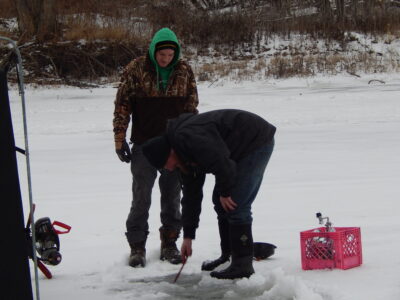
NEW ULM -- Brothers Evan and Kyle Webster of New Ulm took advantage of the mild weather Tuesday to ice fish on Lake Hanska and the Minnesota River.
Kyle Webster said they caught a 14-inch walleye fishing for two and a half hours near the Brown County Park beach on Lake Hanska Tuesday morning.
Late Tuesday afternoon, they put their portable fish house on the Minnesota River, a few steps each of the Minnecon Park boat access in New Ulm.
"You never know what you'll catch on the river," he said.
"The best fishing is around dusk in a 60 to 90-minute window," Kyle Webster added.
Darrin Weigel at Broadway Bait in New Ulm said Lake Hanska was putting out nice crappies recently. He said ice fishing is just starting to get going on Sleepy Eye Lake.
Paul Rieger at R&R Bait & Tackle, New Ulm suggested fishing the Minnesota river near Minnecon Park and areas south of it.
The Lake Hanska Fire Department 10th Annual Ice Fishing Contest is scheduled for 11 a.m. to 3 pm., Saturday, Jan. 27. Everything takes place at Geiger Landing off CR 20 and CR 10. Registration starts at 10 a.m. The public is invited.
About a foot of ice was reported off the main landing access and off of Geiger access, according to the ice fishing tournament Facebook site.
Lake HanBrown County Sheriff Jason Seidl said no ice can ever be considered completely safe ice.
"You can have 18 inches in one spot and very unsafe ice in other places, especially with the heat and cold this year," said Seidl.
The Minnesota Department of Natural Resources (DNR) reports it does not measure ice thickness on Minnesota.
"Your safety is your responsibility. Check ice thickness frequently," reads the DNR ice safety website.
"Frozen lakes are not parking lots," reads the DNR website. "Cars, pickups or SVUs should be parked at least 50 feet apart and moved every two hours to prevent sinking. Make a hole next to the car. If water starts to overflow the top of the hole, the ice is sinking. It's time to move the vehicle."
For more information, call the DNR at 1-888-646-6367. Email the DNR information center at info.dnr@state.mn.us.