
‘They will need this type of facility someday’
Torkelson and Dahms get feedback from Oak Hills officials, residents
Trending
NEW ULM -- State Representative Paul Torkelson and State Senator Gary Dahms visited Oak Hill Living Center Friday.
Oak Hills and other senior care facility supports have led the charge in demanding state legislators take action on the growing funding and staffing crisises in rural nursing homes. Torkelson and Dahms lent their support to this issue during the last session. They were successful in getting some additional funding for rural nursing homes like Oak Hills, but staff said the problem is far from over.
The legislators began their visit with a tour of Oak Hills given by Wendy Broderson, the Oak Hills Fund Development Director. Broderson gave an update on the history of Oak Hills. The facility opened in 1995 with 94 seniors in the skilled nursing facility and 16 seniors in assisted living. In 2003, an additional branch was added with 16 additional assisted living apartments. These 16 apartments are Department of Housing and Urban Development (HUD) houses. In 2008, Oak Hills completed a remodel.
Broderson said Oak Hill wants to expand the facility, which would include remodeling and updating the original apartment units. Oak Hills is hoping to reconfigure the living center households and improve the HVAC system if approved for a grant during the next budget cycle.
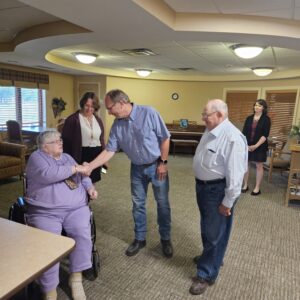
During the tour, Torkelson and Dahms met with some of the residents. They spoke with Chuck Leske in the social room. Leske is a lifelong resident of New Ulm. He has lived at Oak Hills for five years. Leske said his favorite part of Oak Hills is the additional help he gets from the staff.
Later, the legislators met Carline Carmichael, who thanked them for visiting. Carmichael has been at Oak Hills for the last year.
"I am thankful to have this facility," she said, praising the staff and the level of freedom she has at the facility. With transport bus access she can still visit different parts of New Ulm, she isn't restricted to the building.
"I hope you gentleman can courage others to understand they will need this type of facility someday," Carmichael said to Torkelson and Dahms.
Jeanette and Paul Landsteiner also met with the legislators. Paul is a disabled Vietnam veteran living at Oak Hills. Jeanette said it took months to get Paul back to New Ulm after his stroke, but wanted him home for the community connection. It has been easier for Paul to be in a community surrounded by family.
Jeanette said she hopes nursing homes in greater Minnesota can stay open. Without it, Paul would likely need to be cared for at a facility further away from family.
Following the tour, Torkelson and Dahms sat down for a conversation with members of the Oak Hills Foundation board and staff about growing concerns for the future of rural nursing and assisted living homes. Some of the staff expressed anxiety over the recent closure of rural nursing homes. The need for skilled nursing facilities is rising, but funding for the homes not keeping pace.
State reimbursements to nursing homes have been delayed by nearly two years. Oak Hills Administrator Candas Schouviller said the Medicaid cost report is always delayed, forcing Oak Hills to cover upfront costs. With the recent inflation, Oak Hills struggles to cover its expenses.
Schouviller said the extra funding nursing homes received during the last session is helping, but will only help Oak Hills through 2024.
"It is scary to think what will happen after 2024," she said.
Staffing shortages are another problem. Rachal Becker said nursing homes struggle to maintain staffing. Many of the skilled nurses working at Oak Hills and other care facilities can receive a higher wage at hospitals. She said it is a struggle to get skilled nurses to stay.
In the latest legislative session, the wages for Personal Care Assistants (PCA) were increased to $25 a dollar. There is a concern that Oak Hills could lose Certified Nursing Assistants (CNAs) who want a higher wage than a PCA.
Broderson said the labor pull is limited in Greater Minnesota. When wages are not raised evenly, it causes nursing homes to lose workers to the higher-paying institutes.
Broderson asked the legislators what they can do to keep their advocacy going ahead of the next budget cycle.
Torkelson said the state budgeting process is for two years. There would likely not be any budget work this cycle unless a supplementary budget is passed.
Dahms said at the Capitol there is a misunderstanding that Medicaid payments are not in line. He said when looking at the average pay for skilled nursing it looks fair, but in rural Minnesota, there is a pay gap that is being overlooked.
"They need to look at rural Minnesota and how many nursing homes are in trouble and why they are in trouble," Dahms said. "It's not because you are overspending, it is because the staff is paid less than those positions in most other institutions."
Dahms said going forward, they would need to walk a fine line in communicating the needs of rural care facilities. He said they needed to look like negotiators and not complainers.
"We have to keep showing what is happening in rural nursing homes and why it is happening," he said.