
Following footsteps from past
Katie guides present-day kids through Dakota attack
Trending
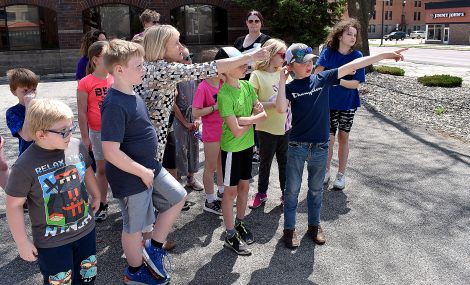
NEW ULM -- Third-graders from Jefferson Elementary School followed in the footsteps of Katie Gropper on Tuesday.
The students took part in a historic walking tour, led by Brown County Historical Society research librarian Darla Gebhard. The tour follows the actions of U.S./Dakota War survivor Katie Gropper, who was 10 years old during the conflict.
Gropper would experience firsthand the two battles of New Ulm on Aug. 19 and 23 in 1862.
The tour started at the Brown County Museum at the corner of Broadway and Center. When news of conflict at the Lower Sioux Agency reached New Ulm, Gropper was attending school with her siblings at Turner Hall. The school was promptly let out and the kids were sent home. Gropper traveled down Center Street to Broadway and proceeded north to her home.
Gebhard led the students down Broadway Street, pointing out historic features. She explained the barricade that would eventually be built by New Ulm defenders did not include Broadway.
The tour reached Third Street North and Broadway Street, near where Gropper's home was located. Broadway Haus is located about where her home once stood.
Unfortunately, by the time Gropper made it home that day her family learned a recruiting party had been attacked by the Dakota. Her family was forced to leave the home and seek shelter in the three-block barricade built around downtown New Ulm.
The tour proceeded to the Kiesling House at Third Street North and Minnesota Street. Gebhard explained the Kiesling House was the only wood-frame building from 1862 still standing. Nearly all buildings outside the barricade were burned.
Gebhard said many of the buildings outside the barricade were burned by the New Ulm settlers to remove any shelter from the approaching Dakota. Without any structures outside the barricade, the Dakota were forced to cross the open field. Unfortunately, Gropper's home was burned during the conflict.
The students continued south on Minnesota Street, learning about how the hotels were made into temporary hospitals to house the wounded. Gropper and the rest of the children would take shelter in the Erd building. Mattresses were placed over the windows of the building to block gunfire. Witnesses heard bullets hitting the mattress.
The tour concluded back on Center Street. Gebhard explained Center Street was the south end of the barricade and during the second day of the battles, defenders left the barricade to drive the Dakota out of a blacksmith shop.
This was a turning side of the conflict. The Dakota made no further advances. New Ulm was evacuated shortly after with the refugees fleeing to Mankato.
Gebhard said she helped create the Katie Gropper tour in 1987 with the help of the children's librarian Holly Risau. The tour has been given to numerous New Ulm students in the decades since. The tour is especially effective for third-graders because many are the same age Gropper was when the conflict happened.
Gebhard said the good news is Gropper lived to eventually become one of New Ulm's first school teachers.
Other third-grade classes will be taking the same tour over the next few days.
This August will mark the 160th anniversary of the two battles.