
NU man leads Nehl’s Park buckthorn battle
Cuts invasive plants in Nehl’s Park
Trending
NEW ULM -- A retired Martin Luther College director of academic computing is leading efforts to remove buckthorn from Nehl's Park, and he doesn't plan to stop anytime soon.
Dr. James Grunwald lives at the south end of Roslyn Road in New Ulm, which adjoins the park, so he doesn't have far to go to remove the invasive shrub that can grow into small trees if ignored.
Bright, green buckthorn leaves may look attractive but buckthorn berries can produce a severe laxative effect that may kill small birds who may distribute buckthorn seeds a long distance.
When they fall to the ground, buckthorn alters the soil, enabling weedy species like invasive, noxious garlic mustard to grow.
Because it shades out and out-competes native ground cover plants, it's bad news for water quality. Native ground cover helps stabilize soil and retain and absorb rainwater.
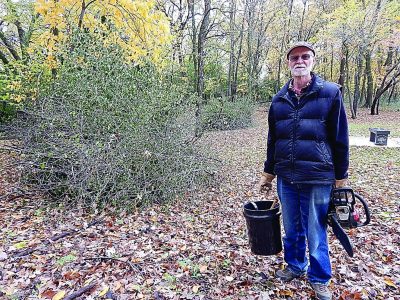
A disc golf enthusiast, Grunwald said Nehl's Park visitors often ask him what he is doing when they see him in the park with a chain saw and a bucket with shears, herbicide and an applicator for buckthorn stumps.
"We've cut a lot of buckthorn here," Grunwald said standing in the southwest corner of the park that borders Flandrau State Park.
He has applied for and received several small grants from Thrivent Financial on behalf of the New Ulm disc golf league to help pay for buckthorn removal supplies.
"People need to take ownership of it and cut it (buckthorn)," said Grunwald.
For removing buckthorn seedlings and smaller plants, hand removal works well. Pliers or a small shovel may also be used. For plants with a trunk up to 2.5 inches in diameter, a Weed Wrench may be used to rip stumps and roots from the ground.
After buckthorn has been removed from your land, walk your property at least once a year and removed new buckthorn plant, according to buckthorn specialists.
Buckthorn management is a multi-year commitment as seeds in the soil can germinate for many years.
Fall and early spring are the best time to find buckthorn as most other plants are without leaves.
Late October and November is the best time to learn how to identify buckthorn. It's leaves are egg-shaped and shiny, with wide-spaced veins at the top of the leaf.
If you nick the thin bark of brush or trees and see a bright orange color, it's buckthorn.
Removing trees with dark berries are important to stop buckthorn from spreading. Berries should be buried, burned or composted.
For questions or help, contact Ellen Vancura by emailing newulmbuckthorn@gmail.com.
Grunwald is the superintendent of Amazing Grace Virtual Academy (AGVA), which provides a fully online high school education option for students unable to attend a traditional WELS/ELS high school. He also teaches courses on how to teach online.
"(Buckthorn removal) gets me away from my computer for a few hours each day," said Grunwald.
Some of his other interests are gardening, home remodeling, and traveling.
(Fritz Busch can be emailed at fbusch@nujournal.com).