
MDA offers mental health, farm safety resources for producers
Trending
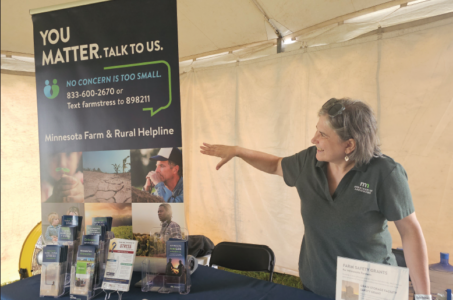
GILFILLAN ESTATE -- The Minnesota Department of Agriculture recently provided mental health and farm safety resources to producers at Farmfest.
The outreach focuses on farm families dealing with high commodity, input, and fuel costs, Sue Knott, a representative with the department, said. Knott said farming carries a different kind of stress than other jobs because work and home life share the same property.
"Mental health issues and the stresses of farming are different than other fields," Sue Knott, a representative with the Minnesota Department of Agriculture, said. "Costs are high, fuel and everything, and it's really hard on them."
Knott said economic pressure can also create physical safety risks on the farm: exhaustion, anxiety, and sleep deprivation raise operator fatigue, which increases the chances of machinery entanglements, tractor roll-overs, or grain bin accidents during routine daily operations.
To assist rural residents facing emotional or economic strain, the state operates the Minnesota Farm and Rural Helpline as a confidential, round-the-clock resource. Callers connect directly with trained professionals familiar with agricultural operations, rural culture, family dynamics, and financial pressures unique to farming.
Minnesota also funds rural mental health counseling through state legislative appropriations. Three state-contracted counselors provide in-person or telehealth appointments across Minnesota without out-of-pocket costs, health insurance requirements, or copays.
For producers facing severe financial hardship, the Minnesota Farm Advocates program offers one-on-one assistance. Farm advocates assist producers with lender negotiations, debt restructuring, farm succession planning, land transitions, and crisis mitigation.
Outreach materials for state stress programs are published in English, Spanish, Somali, and Hmong to ensure accessibility for agricultural workers across the state.
The department also connects new and retiring producers through a farmer mentorship program aimed at operations without a designated heir.
Established farmers looking to transition out of the business are matched with beginning farmers seeking land, equipment, or guidance, and the program allows both sides to post listings for sales, mentoring arrangements, and job openings.
State outreach programs focus heavily on practical hazard prevention alongside mental health, featuring Lock Out and Tag Out equipment designed to prevent workplace entanglements and grain bin engulfment. Lock Out and Tag Out procedures involve attaching a physical lock and bright warning tag to an electrical panel, switch, or power take-off point before a worker enters a grain bin or performs maintenance on machinery.
The process requires workers to notify everyone on-site that equipment will be shut down, isolate all energy sources, zip-tie the warning tag to the disconnect switch, and test the switch to confirm that stored power is dissipated.
Under state safety guidelines, the individual who attaches the lock and tag keeps the key, ensuring that no one else can restart the machine while maintenance is underway.
In addition to safety protocols, the state provides matching grants to assist producers with safety retrofits. The Rollover Protective Structures rebate program covers at least 70% of the purchase, shipping, and installation costs for roll bars and seatbelts on tractors built before 1987, capping the farmer's out-of-pocket expense at $500.
The state also administers the Grain Storage Facility Safety Grant program, which reimburses producers 75% of eligible expenses for purchasing and installing safety equipment on grain bins and silos.
Eligible items include fall protection systems, guardrails, ladder cages, equipment shields, and auger safety covers, with maximum reimbursements set at $400 per bin or silo and up to $2,400 per farm each fiscal year.
Knott said family members, neighbors, and agricultural lenders should watch for signs of severe stress, such as chronic fatigue, irritability, social withdrawal, or neglected farm chores and livestock care.
Knott said the helpline, counseling connections, financial advocacy services, and safety grant programs remain available to producers year-round.
Producers interested in applying for tractor safety rebates or grain storage grants can complete online forms through the department's website or request paper applications by calling the Minnesota Department of Agriculture directly.
Grant funds are awarded on a first-come, first-served basis as legislative appropriations become available each fiscal year.
Knott said the department's Farmfest outreach, developed with University of Minnesota Extension and the Upper Midwest Agricultural Safety and Health Center, began roughly a decade ago as a handful of demonstrations before growing into its current exhibit space.
Community members interested in learning how to support struggling neighbors can also participate in state-sponsored rural mental health training programs, such as the Changing Our Mental and Emotional Trajectory program offered in partnership with University of Minnesota Extension.
The two-hour course teaches rural residents how to recognize signs of distress and initiate supportive conversations before a situation turns into a crisis.
The Minnesota Department of Agriculture also collaborates with regional agricultural organizations and local extension offices to ensure that information regarding farm safety and mental health resources reaches rural communities across all 87 counties in the state.
Local field staff and regional educators distribute informational materials at county fairs, regional agricultural expos, and local producer meetings throughout the year.
Knott emphasized that mental health challenges and physical safety risks often intersect in high-stress work environments, particularly during peak agricultural seasons such as spring planting and fall harvest.
During these busy periods, long work hours and tight operational windows increase physical exhaustion, making proactive safety measures and accessible mental health support critical for farm worker well-being.
State health advocates recommend that farm operations incorporate routine safety checks and stress management discussions into daily farm management routines.
Establishing regular equipment inspection schedules, maintaining clear emergency response protocols, and encouraging open communication among family members and employees help reduce workplace hazards and manage operational pressures effectively.
In addition to state-funded programs, various non-profit organizations and regional agricultural associations offer supplementary resources for farm families navigating financial or operational transitions. These organizations provide peer support networks, financial literacy workshops, and legal guidance tailored specifically to the needs of rural agricultural communities.
"No concern is too small," Knott said, encouraging producers and their families to reach out for assistance whenever pressure builds.