
Drones take flight at Farmfest
Trending
REDWOOD COUNTY – Five drone companies, Drone Nerds, CRK Aerial, Frontier Precision Agriculture, Mountain View Ag, and TerraXplore, represented agricultural unmanned aerial technology at Minnesota Farmfest, demonstrating commercial systems used for crop protection across southern Minnesota.
Daniel Nelson, owner of Mountain View Ag based in Mountain Lake, operates dealership locations in Mountain Lake, Morris, and Olivia. Mountain View Ag sells spray drones, provides flight instruction, stocks replacement parts, and services aircraft.
Representing Mountain View Ag at Farmfest were team members Carter Serbus, Logan Anderson, Jake Mehlhouse, Cooper McCosh, Mitch Moser, Josh Fast, Grant Regier, owner Daniel Nelson, and Britton Pankratz.
"I've been in the spray business for about four years, but this is year one for Mountain View Ag," Nelson said. "I do the sales and service for all the drones. We sell them and teach farmers how to fly them, then support them throughout the season with parts and any questions they have."
Nelson reported that Mountain View Ag currently has approximately 80 drones active across the region.
While his team performs some custom application for nearby neighbors and family members, the primary focus of the business is selling aircraft directly to producers and supporting their independent farm operations.
When comparing drones to traditional fixed-wing agricultural aircraft or ground rigs, Nelson highlights precision handling, edge control, and deep canopy penetration as primary factors driving grower interest.
"Drones do a great even coverage across the field, making a consistent height," Nelson said. "They can get corners, edges, along power lines and trees really well. And you use the air movement from the drone, which blows it down into the crop. So it gives it a really good deposition deep into the canopy of whatever you are spraying."
Dustin Schluter, a Wood Lake farmer and sales representative operating out of Hancock alongside fellow salesperson Clint Ditterman, also exhibited specialized commercial equipment at the show.
Schluter operates two XAG P150 Max drones for his family's corn and soybean farm while offering custom application services to nearby producers.
"Mostly guys hire us for custom spray, but there are becoming more and more farmers buying them for their own operations as well," Schluter said. "It's made fungicide spraying more efficient. The planes still get a lot of acres, but the drones are slowly doing more and more."
Schluter cited industry trial data when comparing application effectiveness across standard Midwest row crops, referencing Practical Farm Research, or PFR, a multi-location field testing program that evaluates how equipment, chemical inputs, and management practices perform under real-world conditions.
The independent trials compare crop coverage, drift mitigation, and yield impact across ground sprayers, airplanes, and multi-rotor drones to provide producers with objective, field-tested data.
"Becks did their PFR trials," Schluter said. "They do tests and they compare to a ground rig, a plane, a drone, and they proved that the drones actually have better coverage than both the plane and the ground rig when the pilots operate them right."
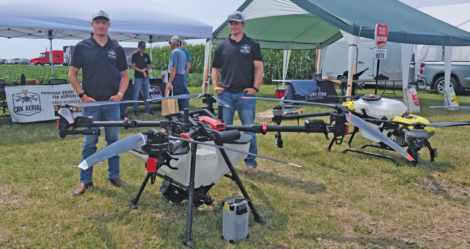
The Farmfest display by Hancock-based CRK Aerial featured commercial models, including the Ceres Air Black Betty and the XAG P150 Max USA.
When growers purchase a complete drone package, it typically comes standard with six heavy-duty batteries and two dedicated chargers to maintain continuous flight rotations throughout an entire spraying day.
Ditterman said that managing flight power efficiently relies on rapid turnaround times during active spraying passes over fields.
"For one of those batteries, it takes about eight minutes to charge," Ditterman said. "Usually, you can spray all your chemical before the drone needs to come back. So you'll run out of chemical before you'll run out of battery unless you're spraying two gallons an acre."
To maintain those rapid charging cycles out in the field on a service trailer or back in the farm shop, specialized electrical setups capable of handling high voltage are required.
"Those require three phase or you can charge on single and three phase, but three phase is quicker," Ditterman said, referring to industrial three-phase power that delivers the steady electrical current needed for fast charging without overloading circuits.
Beyond mastering flight controls and battery management schedules, Schluter outlined the strict federal and state regulatory requirements that operators must fulfill before taking to the skies over commercial cropland.
"You have to take a Part 107 license, which is the FAA unmanned aircraft pilot's license," Schluter said. "If you are doing custom spray, you have to take your commercial applicator's license with the aerial part involved. Then you have to get an exemption from the FAA so that you can fly drones that are over 55 pounds."
Even with the detailed certification process, Schluter emphasized that keeping up with the rapid pace of innovation remains an ongoing part of the business. "It's like every week there are improvements, they're always coming out with new updates," he said.
Together, the five exhibiting vendors highlighted the expanding scope of unmanned aerial technology in modern farming.
Drone Nerds, a national enterprise dealer, brought a broad equipment lineup spanning agriculture, public safety and other industries.
CRK Aerial, based in Hancock, specializes in heavy-lift spray and spreading drones, including the Ceres Air Black Betty.
Frontier Precision Agriculture, with a location in Morris, offers aerial spray systems alongside broader precision-ag and mapping services.
Mountain View Ag, based in Mountain Lake, focuses on drone sales, flight training and season-long service support for growers.
TerraXplore, an Iowa-based DJI authorized dealer, specializes in DJI Agras spray drones with an emphasis on parts availability and post-sale support.
Their combined presence at Farmfest underscored how rapidly precision drone platforms are establishing a permanent foothold across southern Minnesota's agricultural landscape.