
Antique equipment at Farmfest
Trending
MORGAN -- Visitors at Farmfest stepped back in time this week as a collection of vintage tractors and historic farm machinery was showcased in the antique display area at the Gilfillan Estate.
Organized in part by the Prairieland Flywheel Two-Cylinder Club, the gathering highlighted the evolution of regional agricultural technology, featuring working hit-and-miss engines, restored tractors, and early field implements.
Tucked away near the edge of the display grounds near the historic white farm buildings, the antique section provided a living timeline of agricultural innovation for attendees navigating the estate.
Complete with food vendors, shaded picnic tables, and live music provided by performers like Cowboy Dave singing country tunes, the exhibit offered the public a chance to step back into the past, where mechanical simplicity, heavy iron, and pure ground-driven power reigned supreme across Midwest fields.
The antique section featured an expansive lineup of meticulously restored iron legends that served as a testament to early manufacturing, spanning a wide range of designs, fuel systems, and operational uses.
Displayed prominently along the grass row beneath an American flag was a green 1922 Aultman-Taylor tractor featuring giant red spoked wheels, an overhead canopy, and yellow lettering depicting its 60-brake horsepower and 30-drawbar horsepower rating.
Nearby sat distinct row-crop workhorses, including a green John Deere 430, a John Deere 3010, a John Deere Model 70 Diesel with power steering, a green John Deere 4030, a 1963 John Deere 300 Diesel brought in as part of a tribute display, and classic Farmall, Minneapolis-Moline, and Allis-Chalmers units.
Iconic International Harvester Titan tractors, featuring steel spoked wheels and heavy flywheels, also sat lined up along the shade trees.
Among the rare industrial units on display was a bright red 1941 W.F. Hebard Shop Mule. Display signage read that the Shop Mule was originally purchased by Lee Hackett during the summer of 1941 and was utilized in rail yards, mills, and airports for towing trailers before undergoing extensive engine, brake, and body restoration by subsequent owners.
Beyond the tractors themselves, the exhibit showcased a diverse assortment of working homestead implements and stationary equipment that built rural communities, including a blue Letz mill.
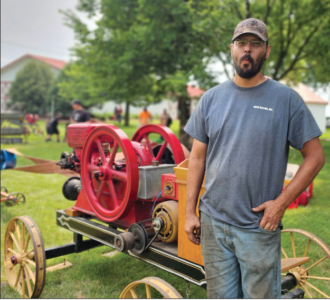
Jon Simning of Franklin brought a large personal collection of operational hit-and-miss gas engines, water pumps, corn shellers, and cement mixers to the grounds.
Simning explained that these general-purpose stationary engines were historically essential on Midwest homesteads, providing the belt-driven mechanical power needed to shell corn, pump water for livestock, run feed mills, and drive cement mixers.
Simning got his start collecting and restoring vintage equipment through a neighbor who collected machinery, as well as an uncle who restored equipment at their shop.
Having displayed his running vintage equipment at Farmfest annually since 2008, Simning said it took labor and dedication required to keep historic iron operational.
Pointing to a running 1920s-era engine, he remarked on the contrast between early manufacturing standards and modern production, emphasizing the durability of early 20th-century machinery.
"They made things way better back in the day than they do now," Simning said.
Among the specialized field machinery on display was a fully mechanical, restored 1900 horse-drawn manure spreader. Local collector Dan Kakac explained the intricate mechanics of the historic unit, pointing out how early agricultural design relied on ground-driven power long before tractor power take-offs (PTOs) or hydraulic systems were developed.
As a team of horses pulled the wooden wagon forward, the heavy rear wheels engaged a series of iron cogs and an early differential mechanism designed so the wheels would not bind or skid when making tight turns along field edges.
A ratcheting mechanism slowly advanced a moving apron along the bottom of the wagon bed, feeding material toward the back end where rapidly rotating beaters distributed it across the topsoil. The machine also featured specialized metal deflector flaps along the bottom to catch drippings.
"Using the manure as fertilizer, they had to get rid of it from the cattle. So what's better than just regenerate? Put it back into the soil," Kakac said.
For older farmers in attendance who grew up loading similar wagons by hand with a pitchfork, standing beside the turn-of-the-century spreader brought back memories of manual labor and the mechanical developments that reduced field work.
For older attendees, walking through the array of different tractor builds offered an opportunity to share community history.
Former Morgan resident Dick Wasek, 87, now residing at Garnett Gardens in Redwood Falls, spent the morning viewing the machinery and reflecting on the region's agricultural past.
Wasek recalled growing up on a family farm where John Deere tractors were widely used, remembering how neighborhood children in the 1940s would interact with the slow-moving equipment.
Wasek parked in front of the1922 Aultman-Taylor in his motorized wheelchair, said, "My dad told me that when they had these, kids used to stand on the wheels and hang on the spokes as they went around."
Wasek added that hearing the idle of two-cylinder engines brought back memories of attending weekend dances at George's Ballroom in New Ulm, as well as venues in Springfield and Gibbon, where local farm hands gathered on Saturday nights.
Visitors from across the region, including attendees traveling down from Osakis in Douglas County, gathered with long-time local collectors under the shade trees to discuss how these machinery models were originally used to clear and farm land across southern and central Minnesota.
For these visitors, watching the flywheel engines operate under their own power provided a direct connection to the generations of farmers who worked the land using manual levers, hand cranks, and clutch pulleys.
While the antique grounds were primarily stewarded by long-time collectors, the display also drew interest from younger attendees.
Among those inspecting the steering gears and mechanical fittings was 12-year-old Brennan Carmichael. Brennan traveled to Farmfest from Knoxville, Tennessee, along with his mother, Kim Carmichael. The pair were in the area visiting Brennan's sister, Caitlin Barber, who resides in Redwood Falls with her husband.
Brennan's interest in vintage mechanics began when his older brother handed down an old tractor.
"His brother gave him an old tractor," Kim Carmichael said, describing how Brennan got his start fixing up equipment before buying and selling more small tractors with his earnings.
Working alongside his father, Brennan restored the initial unit to working order. After selling his first restored project, Brennan used the proceeds to purchase additional small tractors, establishing a self-funded hobby in mechanical restoration.
"He just likes fixing them and likes to buy them and sell them and fix them up," Kim Carmichael said.
For young mechanics like Brennan, Farmfest provided both a learning opportunity and a look at historical engineering, demonstrating how mechanical restoration efforts continue to pass down through generations.