
Who will unite Minnesota?
MN Gov. candidates bring campaign pitch to Farmfest
Trending
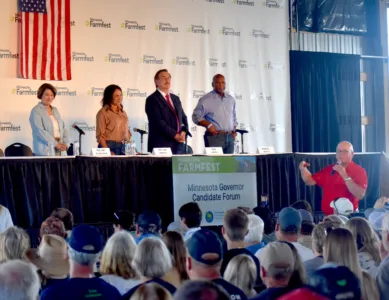
GILFILLAN ESTATE -- The top four candidates running for Minnesota governor gathered Wednesday at the Farmfest forum to answer questions related to agriculture.
Candidates included Democratic candidate U.S. Sen. Amy Klobuchar and the three candidates seeking the Republican nomination in the primary -- State Rep. Lisa Demuth, Mike Lindell and Kendall Qualls.
The forum began with a question of geography. The moderator said there was often a narrative that Minnesota is divided between urban and rural. Each candidate was asked how they would work to connect or unite the state.
Klobuchar said civil debates like the ones held at Farmfest were a great way to start. She believed it was important for the top politicians to visit each county in the state, regardless of political leaning to find out what citizens need.
She believed many of the struggles farmers were facing were things the entire state could unite behind. Klobuchar said political headwinds were strong against change, but that could not be used as an excuse to resist transforming the state for the better.
Demuth believed that now was the perfect time to unite the state. She currently leads the State House of Representatives during a rare 67-67 tie between Republicans and Democrats.
"Everything we passed over the last two years had to be bipartisan," she said. "We have proven that we can do that here in Minnesota."
Lindell said one of his first jobs was helping on a farm and he is aware of rural concerns. He also understands the plight of the metro area. He is a recovering drug addict who and says he worked to put millions of dollars into the Twin Cities to help the homeless and other addicted persons. He has also started a successful business and served as the CEO of My Pillow.
Lindell said his experiences speak for themselves, but also promise to release his budget plan for Minnesota that would call for the state to become income tax free.
Qualls said the real divide in Minnesota is over values. He wanted to return the state to core values that he claimed the Democratic party has rejected.
Economic concerns were a major theme of the forum, specifically in bureaucratic processes. Each candidate was asked how they would speed up permitting processing in Minnesota.
Demuth said the permitting process in Minnesota has held back a wide variety of businesses, not just agriculture. She said some permitting delays can last months or even years, which holds back growth.
Demuth said she would be the first to say protecting the environment was important in terms of safe air and water, but she wanted to reduce regulations and rule-making from the Minnesota Pollution Control Agency (MPCA). Eliminating the delays would be the first step.
Lindell said in his business, he had experience with long permitting delays and as governor, he would cut delays down by improving communications between agencies and pushing things through.
Qualls said the permitting process was one of the reasons Minnesota had become an anti-business state and politicians knew about this for years but took no action. He said as an outsider to politics, he could push for real change. He also believes he could deliver the metro area for the Republican party, which he said was the GOP's Achilles heel for decades.
Klobuchar said removing the red tape on permitting was important to expanding business in the state. She said it was especially challenging to small businesses and rural farmers to wait on a slow-moving government. Her solution to speeding up the permitting process was to require a deadline for approval. If the state cannot review the permit in time, the applicant will get their money back.
She also called for removing the red tape on housing, which the state needs.
On regrowing and stabilizing animal agriculture in the state, Lindell said he would go after the monopolies of meat packers and corporate price fixing. He believed the way to bring animal agriculture back to Minnesota was to lower costs. Lindell especially wanted to help young farmers.
Qualls’ solution to stabilizing agriculture was to get the government out of it. He said farmers know how to run their business and they do not need the state working as an obstacle.
Klobuchar said it was important to protect animals from diseases that could devastate the industry further. She encouraged farmers to seek grants for biosecurity measures. There was also a need for wolf mitigation funding and disaster loans. She also wanted to see more large animal vets in the state. She called for creating a pipeline of kids going into the veterinarian field.
Demuth said animal ag was decreasing because of the delayed permitting process. She said the fact that animal farms are increasing in surrounding states shows that it is too heavily regulated in Minnesota.
Demuth said during the last legislative session they were able to appropriately fund the Minnesota Board of Animal Health and put $1.5 million into the disaster fund to prevent the spread of animal disease.
On the topic of property taxes, Republican candidates called out unfunded mandates as a major burden.
Demuth said the Paid Family Medical Leave (PFML) had put an unfunded mandate on all business regardless of size and increased taxes. The Clean Energy Mandate led to wind and solar installations buying up farm land at higher prices, creating a property tax increase.
Lindell said as governor, he would cancel all unfunded mandates, but also work to create a better system for funding schools. He believed this would lower property taxes by eliminating school bonding referendums that increase property taxes.
Klobuchar, as the lone Democrat, also promised to fight back against the unfunded mandates in the state, but also wanted to make sure counties received local government aid, active school credits and property tax credits. She also wanted to fix the SNAP cuts, which placed the burden on counties and had effectively created a tax increase.
Candidates were also asked how they would lead if another surge of ICE officers came to Minnesota.
Demuth said she would enforce the immigration laws as written, but acknowledged there needed to be immigration reform on the federal level.
"I will be supporting the federal immigration laws and expecting those in Washington to finally do their jobs and make the meaningful changes to allow legal immigration," she said.
Lindell said as governor, he would work with federal officials to make sure illegals are removed from the state. By working with the federal government, he believed they could avoid surges altogether. He also wanted to go after employers who are knowingly hiring illegals. Lindell called for a crackdown on protesters who break the law.
Qualls wanted to eliminate the idea of a sanctuary city and a sanctuary state. He said if the state follows the rule of law, there would be no metro surge.
Klobuchar said she was long in favor of increasing security at the border, but she was against the actions of ICE. She called out all three Republican candidates for not doing the same.
"Two innocent people were killed," she said. "We had many people arrested when they were not supposed to be, we need reform to ICE."
Klobuchar said the $70 billion going to ICE makes it a bigger agency than FBI or even the U.S. Marines.
"I think that $70 billion should go to you for health care or child care," she said.
Fraud was another major concern brought up in the forum.
Lindell said fraud was the greatest blessing to the state because it opened the eyes of people to remove the current state government. Lindell said that along with his Lt. governor, they would do a deep dive into Minnesota's programs, looking for cuts, calling it "Minnesota DOGE." The program would also look at the program in terms of investment.
Qualls called for greater accountability and consequences for those who allowed the fraud to happen. He also wanted an elimination of large spending bills. He wanted single-item bills.
Demuth said fraud was the direct result of incompetent Democratic control for 16 years. In her time in the House, she pushed for whistleblower protections in the Office of Inspector General.
Klobuchar said the people of Minnesota were ripped off and it should have been caught sooner. As governor, she would hold a top to bottom audit and vet all contracts with surprise inspections.
"People who commit fraud should go to jail, but we need to do more," she said.
She called for extending the statute of limitations of prosecuting the fraud to make sure those responsible face jail time.
Each candidate made a final pitch with a closing statement.
Klobuchar said that currently, the farmers are facing a perfect storm of ugly consequences caused by the Trump tariffs and the war in Iran, which have increased costs to farmers.
Her plan as governor is expanding domestic and international markets, keeping strong rural hospitals and making sure housing and the workforce is available.
"We do not need a governor who is a rubber stamp to Donald Trump," Klobuchar said.
She believed Minnesota could find new markets, but it would require building trust by taking on fraud and reforming the government.
Demuth wanted to create a stronger state by creating a top-down change of government and accountability for the fraud. Her vision is to eliminate fraud, lower taxes and grow agriculture.
Lindell said he has lived the American dream, but believed Minnesota was in a spiritual battle for evil and good. He claimed Gov. Tim Walz placed a satanic statue in the state capitol. He also cited his efforts to prove the 2020 election was stolen, claiming he personally was working on election security.
Qualls believed Minnesota needed a political outsider in the governor’s office because for 20 years, politicians on both sides hurt the state. He blamed Democrats for creating an anti-business state and blamed Republicans for not doing anything to stop it.
"This is why we need different leadership at the state today," he said.
The Minnesota primary election will be held Tuesday. The general election is Tuesday, Nov. 3.