
Farm Bill ins and outs
MN 1st Congressional District candidates discuss Ag legislation
Trending
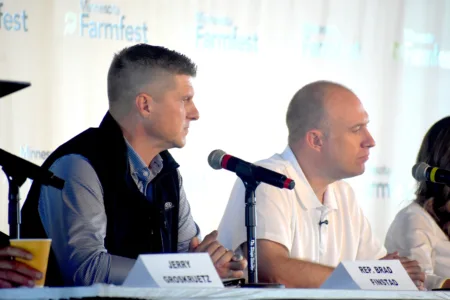
GILFILLAN ESTATE - The Farm Bill was the top topic of conversation during the Minnesota Farmfest congressional forum.
Minnesota's 1st Congressional District candidates Rep. Brad Finstad (GOP) and Jake Johnson (DFL) debated the ins and outs of the bill during the opening congressional forum.
The first question of the forum was weather the Farm Bill would pass in the Senate this year, or it would take another year to pass it.
Finstad said he was proud of the work done to pass the bill through the U.S. House.
"It was a strong bipartisan bill," he said. "It is the largest investment in a Farm Bill since 2002."
Finstad said the bill included Agricultural Risk Coverage (ARC) and Price Loss Coverage (PLC), which were big improvements to the crop insurance title and investments in the security industry.
He said the Farm Bill was now at the Senate’s doorstep and he was optimistic that Sen. Amy Klobuchar would use her ranking position to push it through.
Johnson was also hopeful the Farm Bill would pass this year, but wanted more out of it.
He agreed that there were a lot of good things in the current version of the Farm Bill. He believed the ARC and PLC inclusions were beneficial to farmers, but Johnson was worried about what was not in the bill.
Johnson said the Farm Bill did not address the growing fertilizer costs caused by the war in Iran and addressing export market in terms of tariffs.
Johnson hoped the Senate would make adjustments to address this concern before passing the bill.
Another theme of the forum was how to bring in younger farmers into agriculture. The forum moderator asked about special provisions in the Farm Bill for the younger and newer farmers.
Johnson supported assisting younger farmers. He said there was a program in Minnesota to help younger farmers, but it was too small. The funds for the program were gone too quickly. He supported building on the Minnesota program and extending it to the federal level to ensure the next generation of farmers.
Finstad confirmed there were provisions in the Farm Bill to address young farmers. He said the previous young farmers program was to restrictive, the new language in the Farm Bill gives beginning farmers more affordable risk management tools. There is also USDA pre-approval to give them a better opportunity to acquire land when it is available.
Finstad said going forward, Congress needs to find a method to reduce input costs that are hurting the markets.
Both candidates were supportive of including biofuels and year-round E15 provisions in the Farm Bill. Finstad and Johnson saw the benefit of renewable fuels on Minnesota agriculture market.
"The reality is our farmers want markets," Johnson said. "Domestically, that is in biofuels, that is in year-round E15. That is making sure that we have markets to sell into."
Johnson said another benefit of year-round E15 is that it provides certainty for farmers.
Finstad agreed renewable fuels were important to the health and wellbeing for Minnesota farmers, but it also offered energy dominance for the country.
He believed renewable fuels gave farmers a market that could increase in demand and profits without needing a government handout.
On the topic of rural healthcare, Finstad said in the U.S. House passed a $50 billion rural healthcare investment. The investments could help rural hosptials utilize telemedicine options when in-person visits and access is limited.
Johnson said the $50 billions investment came after the country saw a $137 billion cut for rural healthcare. He said in the first district alone, four rural clinics were closed in the last year.
He said subsidies continue to get cut, forcing farmers to go without health insurance unless they pick up a second job.
"That has got to be unacceptable," Johnson said. "I am advocating for a healthcare system with a robust public option."
The two candidates were of similar opinion on the question of immigration and farm labor.
Johnson said Minnesota had major labor needs and a solution was needed for the H-2A temporary agricultural workers visas.
"We do need comprehensive immigration reform, we do need to secure our border," Johnson said. "Anyone who is here illegally and is breaking the law should be deported and then we need to expand opportunities for those who do want to come here legally."
Finstad said he co-authored a bill to fix the H-2A visa program. He said the H-2A program was created 42 years ago as a temporary solution, but it does not follow common sense.
He said if a husband and wife come into the country with an H-2A visa, only one of them would be allowed to work. The other is restricted from working.
The changes to the temporary visa would expand who could use it and could increase the farm labor force.
During closing statements, Finstad said it was important to reflect on America's 250-year history.
"It is important to remember we are standing on the shoulders of giants," he said. "It is our generation’s time to ask what we are going to do to make sure the next generation has something a little big better than we had."
Johnson said he grew appreciative of the value of hard work, but he also saw the importance of community and how much his neighbors helped him.
He said his family relied on SNAP and Medicaid. He was able to attend college because of Pell grants and subsidized Stafford Loans.
"I got to live the American dream in southern Minnesota and I am so thankful for those who invested in me to make it possible," he said.
Johnson said he chose to run for Congress because he believed the politicians were forgetting people like him and his family.
He wanted to provide a working class voice to the halls of Congress.
The Farmfest candidate forums continue on Wednesday with the Governor's and U.S. Senate forums.