
The German Bohemian Heritage Society
Keeping German Bohemian language and history alive
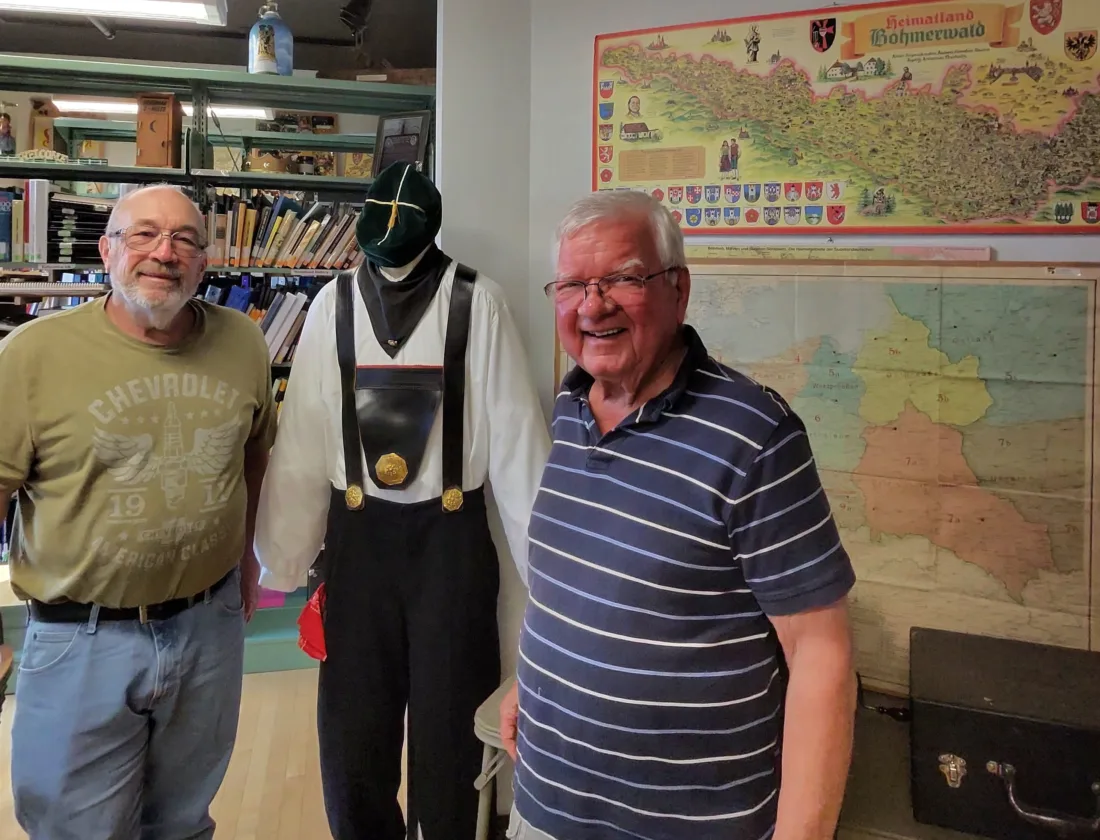
German-Bohemian Heritage Society board members Rick Eckstein, left, and Pat Eckstein stand inside the organization's research library in New Ulm beside historical maps and traditional heritage attire. (Photo by Amy Zents)
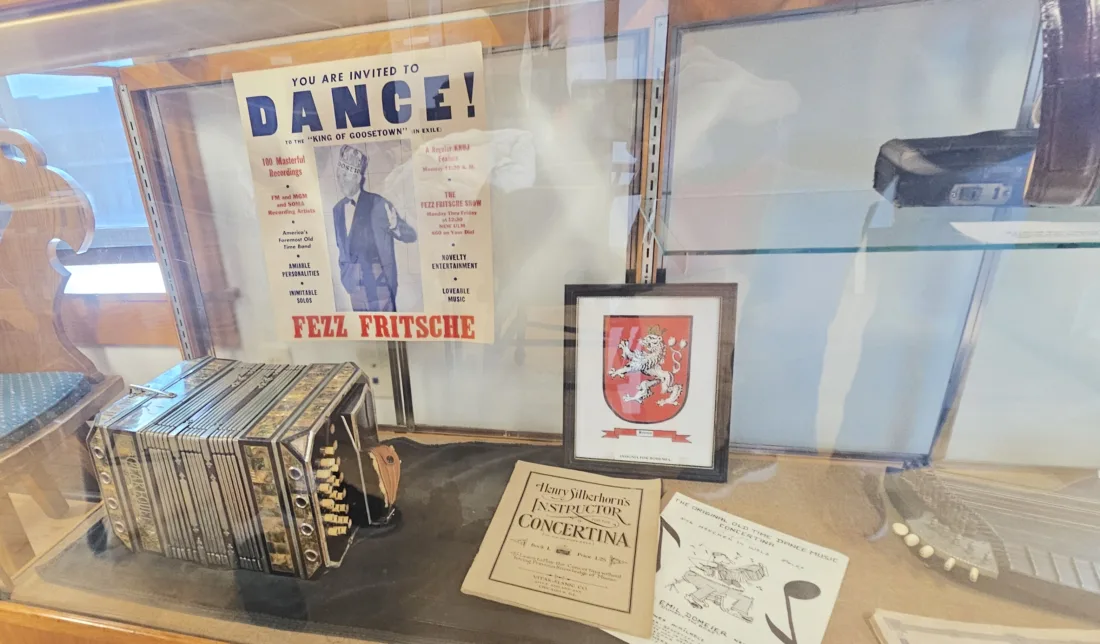
A display case inside the research library features a historic concertina and music instruction books alongside a poster for Fezz Fritsche, the "King of Goosetown." (Photo by Amy Zents)
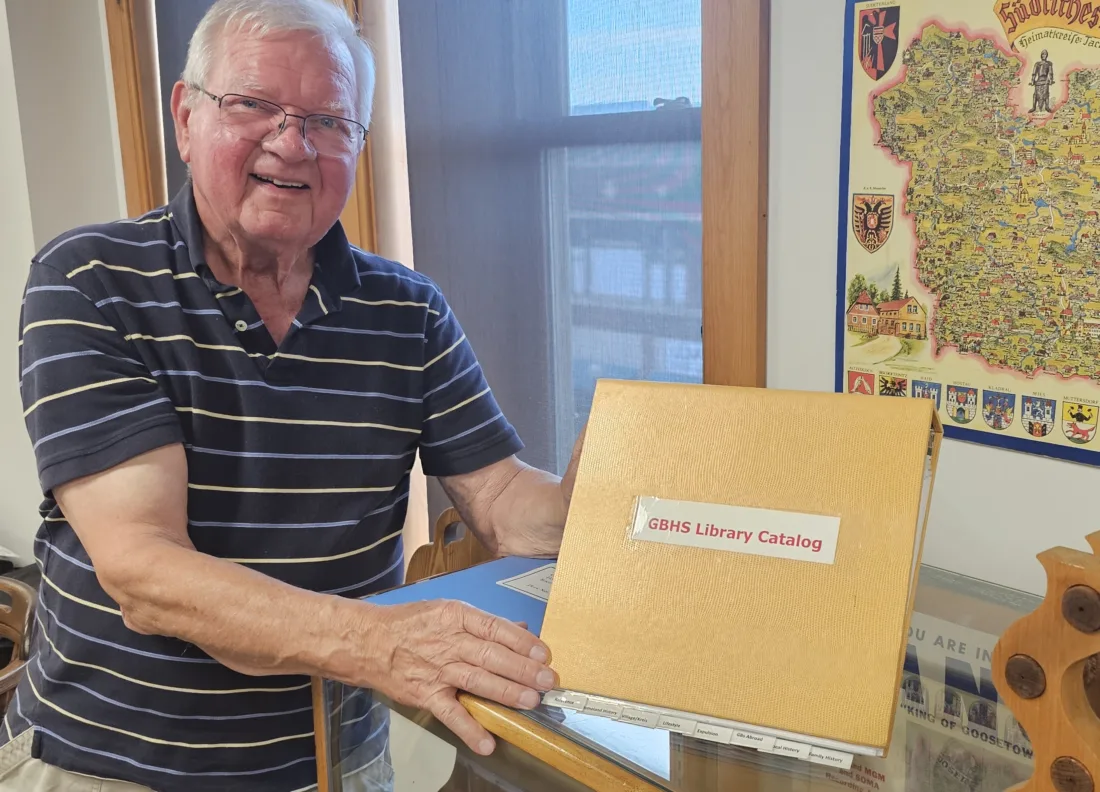
Pat Eckstein displays the German-Bohemian Heritage Society library catalog, which indexes hundreds of regional settlement and family history resources. (Photo by Amy Zents)
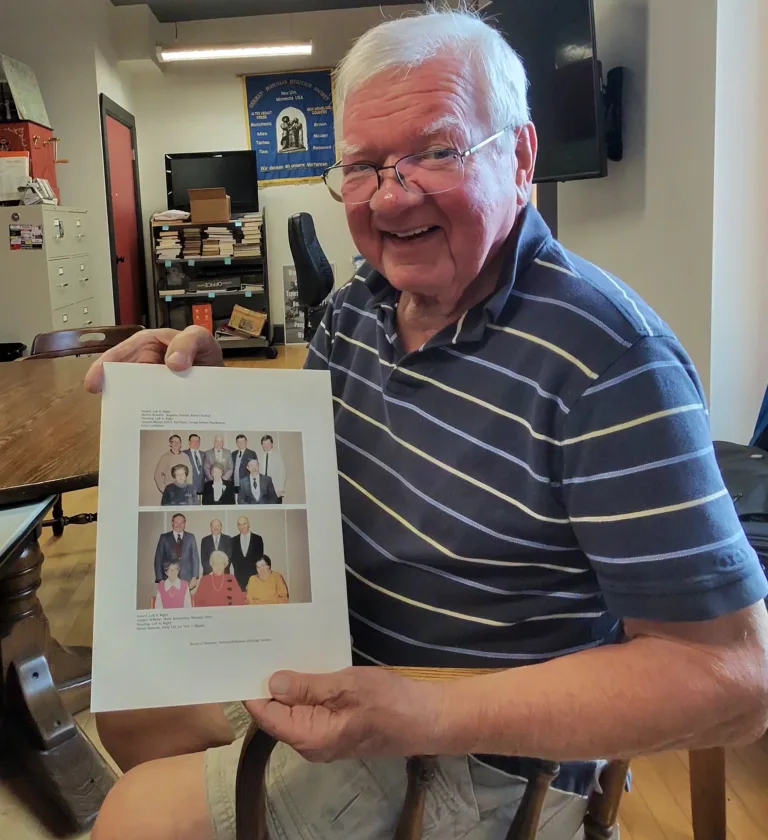
German-Bohemian Heritage Society board member Pat Eckstein holds an archival document showing photographs of early leaders and board members following the organization's formation in 1984. (Photo by Amy Zents)
German-Bohemian Heritage Society board members Rick Eckstein, left, and Pat Eckstein stand inside the organization's research library in New Ulm beside historical maps and traditional heritage attire. (Photo by Amy Zents)
A display case inside the research library features a historic concertina and music instruction books alongside a poster for Fezz Fritsche, the "King of Goosetown." (Photo by Amy Zents)
Pat Eckstein displays the German-Bohemian Heritage Society library catalog, which indexes hundreds of regional settlement and family history resources. (Photo by Amy Zents)
German-Bohemian Heritage Society board member Pat Eckstein holds an archival document showing photographs of early leaders and board members following the organization's formation in 1984. (Photo by Amy Zents)
Trending
NEW ULM -- The German Bohemian Heritage Society is continuing its efforts to document and preserve the stories, language, and traditions of the German-Bohemian settlers who arrived in Brown and Nicollet counties in the 1850s.
For more than four decades, the organization has operated a research library, historical archive, and cultural association connecting area residents and descendants to their ancestral heritage.
The society formed in 1984 after local residents recognized that the region’s early German-Bohemian history was at risk of fading over time.
Founding leaders included Harriet Eckstein, Bob Paulson, Dr. LaVern Rippley, and local historian Elroy Ubl. Their goal was to preserve the unique history of settlers who established roots in areas such as Goosetown and surrounding township farmlands.
“They had a vision that they would like to accentuate the accomplishments of the German Bohemian ethnic group that settled around here in those early years,” said Pat Eckstein, current society board member and King of the Bohemians.
The organization currently has about 350 families as members. The membership is based primarily in Brown and Nicollet counties, including communities such as Sleepy Eye, Springfield, and New Ulm.
Regular operations include cataloging historical records, preserving regional music and language, hosting educational meetings, and assisting families with overseas genealogical research.
Shortly after its founding, the organization established the German Bohemian Heritage Singers to perform traditional folk songs from the homeland.
Around the same period, regional native Paul Kretsch compiled a dialect book documenting the specific vocabulary, phrasing, and speech patterns remembered from his youth among early German-Bohemian families in the area.
“Paul Kretsch picked out certain words that he remembered how they were used in phrases and sentences and wanted to put those in that dialect book,” Pat Eckstein said.
While Paul Kretsch compiled the vocabulary and text for the project, his twin brother, Pat Kretsch, provided the recorded audio voice tracks for the dialect book so listeners could hear authentic pronunciation of the language.
The society is currently preparing to digitize those linguistic records by producing video snippets for its website to demonstrate how the spoken dialect sounds to modern listeners.
“We can get that to be an instrument that we can promote our society on our website,” Pat Eckstein said.
Many board members and local residents gathered much of their understanding of the German-Bohemian dialect from childhood exposure on local farms rather than formal classroom instruction.
“I took a couple of years of German in college, but it’s different,” Pat Eckstein said. “I learned most of it from when I was young, listening to neighbors when they were visiting about agriculture things.”
The organization’s library collection was cataloged and indexed by member Gary Wiltscheck, who organized the materials into distinct categories covering homeland history, local village settlement records, reference texts, and stories of the global diaspora.
Holdings include “The Quiet Immigrants,” a history co-authored by Dr. LaVern Rippley and Robert Paulson detailing the daily lives of early area farmers.
The facility also houses an original 1940s German postal zone map donated by member Gerhard Klein, whose father worked as a postman in Germany during the 1930s and 1940s. The society is currently preparing to frame and display the document inside its library.
The organization also works with historical researcher Wade Olsen to facilitate heritage travel to Central Europe. Area participants travel directly to ancestral farmsteads, churches, and historic landmarks across Austria, Germany, and the Czech Republic.
“Our GBHS library is a very good resource for local people to come in, set up an appointment, and we can help them search for family history or show them ways to find where their ancestors came from,” said board member Rick Eckstein.
During recent trips, travelers visited ancestral farmsteads constructed around central courtyards, and local participants were able to play historic church organs in their family villages while area clergy conducted services in their ancestral home towns.
“It’s a very good connection to where we came from,” Rick Eckstein said. “People get to see their ancestral village for the first time.”
The organization also tracks historical records of early local families, including Joseph Eckstein, a second-generation settler from Sigel Township who worked as a teacher and attorney before serving in regional civic and fraternal organizations.
In 1910, Joseph Eckstein received a silver award cup at a convention in Canada. In 1931, his wife repurposed the item as the Eckstein Music Award, which was presented annually to a graduating senior at New Ulm High School for proficiency in music.
While the original silver cup is currently being sought, following past high school building renovations, the tradition endures.
In 1962, the school transitioned the honor to a permanent wall plaque format, and the award continues to be presented to graduating seniors each year.
The society library operates by appointment on the third floor of The Grand Center for Arts & Culture. Research visits can be scheduled by emailing Germanbohemian@gmail.com or visiting gbhsmn.org.