
‘Good to Be a Musician’
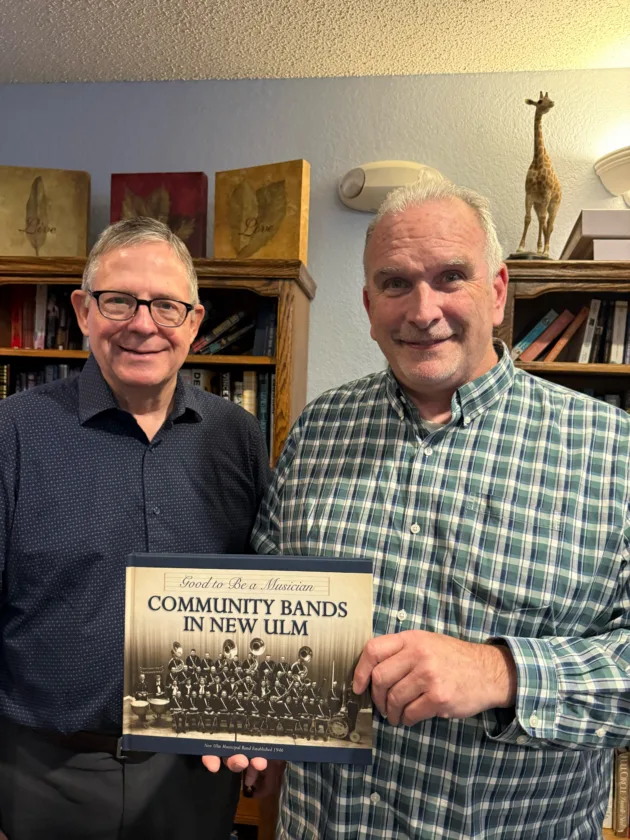
Local historian and author Dan Groebner (left) signs a copy of his book, Good to Be a Musician: Community Bands in New Ulm, alongside Art Keith.(Photo Coutesy of Daniel Groebner)
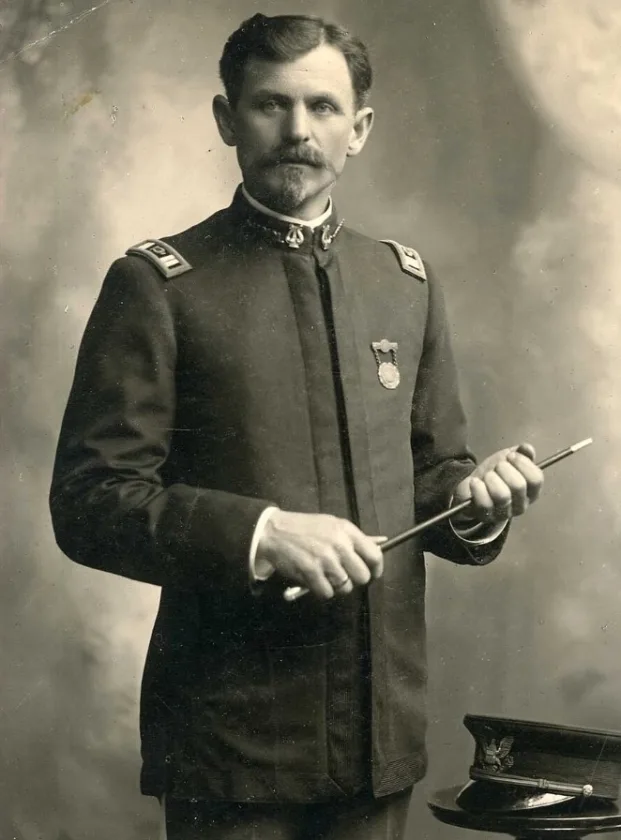
A vintage portrait of Captain Joseph C. Hofmeister, circa 1900. (PhotoSource: Wikipedia (Joseph Hofmeister biographical archive and historical records). Public domain / CC0.
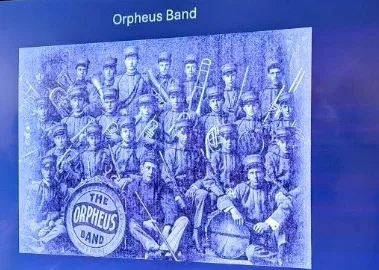
A vintage archival portrait of the Orpheus Band, featuring members in uniform posed with their brass instruments and a bass drum marked "The Orpheus Band Minn." Springfield’s Orpheus Band was notably directed starting in 1923 by Captain Joseph C. Hofmeister, helping shape the rich brass and band heritage of the region.(Image courtesy of the Brown County Historical Society.)
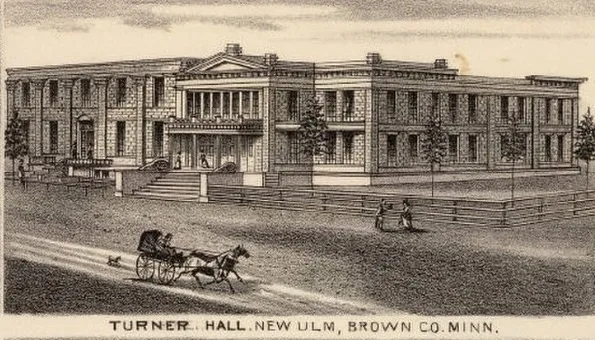
An 1874 archival illustration captures the historic Turner Hall in New Ulm. (Public domain, via Wikimedia Commons.)
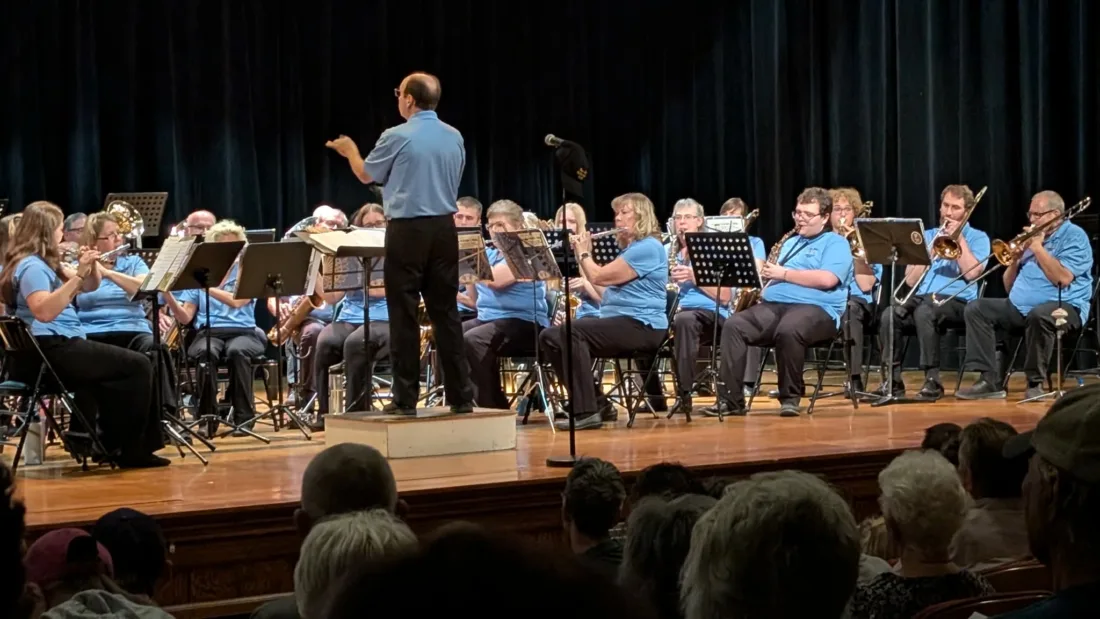
The New Ulm Municipal Band performs under the direction of Don Jirak, continuing a rich tradition of live concert music that has anchored the community's cultural life for eight decades since its founding in 1946. (Photo by Amy Zents)
Local historian and author Dan Groebner (left) signs a copy of his book, Good to Be a Musician: Community Bands in New Ulm, alongside Art Keith.(Photo Coutesy of Daniel Groebner)
A vintage portrait of Captain Joseph C. Hofmeister, circa 1900. (PhotoSource: Wikipedia (Joseph Hofmeister biographical archive and historical records). Public domain / CC0.
A vintage archival portrait of the Orpheus Band, featuring members in uniform posed with their brass instruments and a bass drum marked "The Orpheus Band Minn." Springfield’s Orpheus Band was notably directed starting in 1923 by Captain Joseph C. Hofmeister, helping shape the rich brass and band heritage of the region.(Image courtesy of the Brown County Historical Society.)
An 1874 archival illustration captures the historic Turner Hall in New Ulm. (Public domain, via Wikimedia Commons.)
The New Ulm Municipal Band performs under the direction of Don Jirak, continuing a rich tradition of live concert music that has anchored the community's cultural life for eight decades since its founding in 1946. (Photo by Amy Zents)
Trending
NEW ULM — Step into German Park on a warm summer evening, and immediately be greeted by a timeless sensory experience: the crisp, golden shimmer of polished brass catching the fading sunlight, the steady, rhythmic pulse of percussion, and a cheerful gathering of music lovers filling the terraced amphitheater.
For generations, music has been the heartbeat of Brown County, but beneath the familiar melodies of an evening concert lies a vast, nearly forgotten history of civic dedication, community pride, and small-town harmony.
In his meticulously researched book, “Good to Be a Musician: Community Bands of New Ulm,” local historian and retired physician Dan Groebner opens up the sheet music of the past to a time, in which nearly every township across Brown County had its own active community band.
For Groebner, who also plays the baritone horn, the book is a labor of love and a tribute to the musicians who built the cultural foundation of the region.
In the late nineteenth and early twentieth centuries, community bands were much more than local hobby clubs; they served as the essential social glue of agricultural settlements.
From Sleepy Eye and Springfield to Hanska and Comfrey, local ensembles provided the soundtrack for every major milestone in civic life, performing at Fourth of July parades, funerals, barn raisings, school graduations, and political rallies.
“Community bands not only entertained, they served their towns," Groebner said.
In an era before radio and recorded sound, these musicians acted as cultural lifelines, bringing people together across farming tracts and villages through marches, waltzes, and polkas.
The physical landscape of early New Ulm played a vital role in nurturing this musical culture.
In the 1890s, Union Hall sat on the corner of North Broadway and First North Streets, one block north of Broadway and Center Streets, resting near the center of New Ulm's entertainment district.
Two blocks southwest stood Turner Hall, which remains New Ulm’s oldest surviving entertainment anchor. Union Hall hosted countless dances, concerts, and ceremonies for early ensembles including the Silver Cornet Band, the Concordia Band, and the Great Western Band.
Union Hall also served as the headquarters and armory for Company A of the Second Regiment until the city’s first official armory was built and celebrated with a grand military ball on December 27, 1915.
Groebner's book also covers the colorful characters who shaped this regional soundscape. Among the most prominent figures was Captain Joseph C. Hofmeister, an immigrant born in Bohemia in 1866.
Hofmeister immigrated directly to New Ulm and became director of the Second Regiment Band, rising to the rank of Captain in October 1916.
Hofmeister also directed Springfield's Orpheus Band starting in 1923, composed original works like the “Minnesota Centennial March,” and taught all of his sons to become professional musicians.
Several Hofmeister sons carried that rigorous training into legendary dance halls as members of Whoopee John Wilfahrt’s famous band, earning the family's place in the Minnesota Music Hall of Fame.
Another titan of regional music highlighted in the research is Leo B. “Pinky” Schroepfer, a Sleepy Eye barber by trade and a gifted musician by calling who directed the Sleepy Eye Drum and Bugle Corps starting in 1935.
Under his baton, the American Legion Post 7 group won first-place honors in major competitions across Minnesota, Chicago, and St. Louis more than 20 times, and Schroepfer composed enduring regional works like the “Jubilesta March.”
While many local histories point to 1924 as the dawn of polka in the area with Whoopee John Wilfahrt’s band in Sigel Township, but Groebner's research uncovers an earlier milestone. Authentic Bohemian polka music actually arrived in New Ulm in 1892, when John Lindmeyer arrived and established the Goosetown Band with fellow immigrants who had played together in Europe between 1883 and 1892.
Archival photographs show how early ensembles heavily featured cornets before trumpets gained popularity in the twentieth century under the sweeping influence of jazz greats like Louis Armstrong.
The turbulence of the mid-twentieth century brought profound changes, and when World War II drew many musicians away, those remaining on the home front rallied to reactivate the Pioneer Band in 1941. That ensemble held its inaugural concert on March 30, 1941, on the stage of the Turner Theater under the guest baton of Karl L. King, one of the most celebrated bandmasters of the era who led the renowned municipal band in Fort Dodge, Iowa.
Although the historic Turner Theater building burned down on January 7, 1952, and was replaced by a community gymnasium, King’s connection paved the way for his later consultation on the formal establishment of the New Ulm Municipal Band in 1946.
As the post-war era unfolded, the cultural makeup of the bands underwent a quiet revolution. Historically, community ensembles had been almost exclusively male preserves, but the New Ulm Municipal Band broke ground by welcoming women into its ranks.
“It is simply right that women and girls are allowed to participate in our world when they are willing to be there and to do their part to keep us all safe and happy," Groebner said.
Today, under the direction of Don Jirak, who has led the ensemble since 1999, the band proudly spans generations, from 12-year-olds to 96-year-olds, with an equal balance of female and male musicians, operating on the philosophy that anyone who shows up and tries their best belongs on the bandstand.
What truly sets New Ulm apart is its legendary partnership with the New Ulm Battery, a local artillery unit that provides authentic, thunderous cannon fire during outdoor performances of pieces like Tchaikovsky's “1812 Overture.”
“Hearing and feeling the cannons explode with bright-shining fire into the air is exhilarating," Groebner said. "When the cannons fire smoke rings into the air, the crowd goes wild! And I hear them and want to play my baritone the very best I can.”
The spirit captured in “Good to Be a Musician” connects the past to the present. In 1878, when the Silver Cornet Band first formed, live music was the only way to hear notes played by real people, turning open-air park concerts into essential social gatherings.
Now, listeners can instantly stream music from mobile phones in the comfort of their homes, often enjoying entertainment entirely alone.
Modern community celebrations like Bavarian Blast and HermannFest, where the New Ulm Municipal Band takes the spotlight at Harman Park, keep those brass instruments ringing across the valley, connecting current audiences to the very same parks and streets where early ensembles performed over a century ago.
For Groebner, writing the book was never just about archiving old paper; it was about honoring a living tradition. Whether searching through historical archives or lifting his baritone horn on stage alongside friends and neighbors, Groebner leaves readers with a timeless reminder: “I encourage my friends to enjoy live music.”
Copies of “Good to Be a Musician: Community Bands of New Ulm,” are available through the Brown County Historical Society (BCHS).
Readers who would like to visit with the author about the process of researching and writing the book are invited to a book signing at the BCHS Museum in New Ulm from 11am to 2pm, Saturday, Oct. 10 with a second book signing from 11am to 2p.m. Friday, Nov. 27.
Books will be available for purchase at the museum and the author will be happy to sign any copies purchased that day or previously, and for those who pre-purchased a copy, Groebner will have copies on hand for pickup at the museum.
For questions or additional information, please call 507-233-2616 or email education@browncountyhistorymn.org.