
Seeking the tooth
The search for the missing 1929 New Ulm mammoth molar
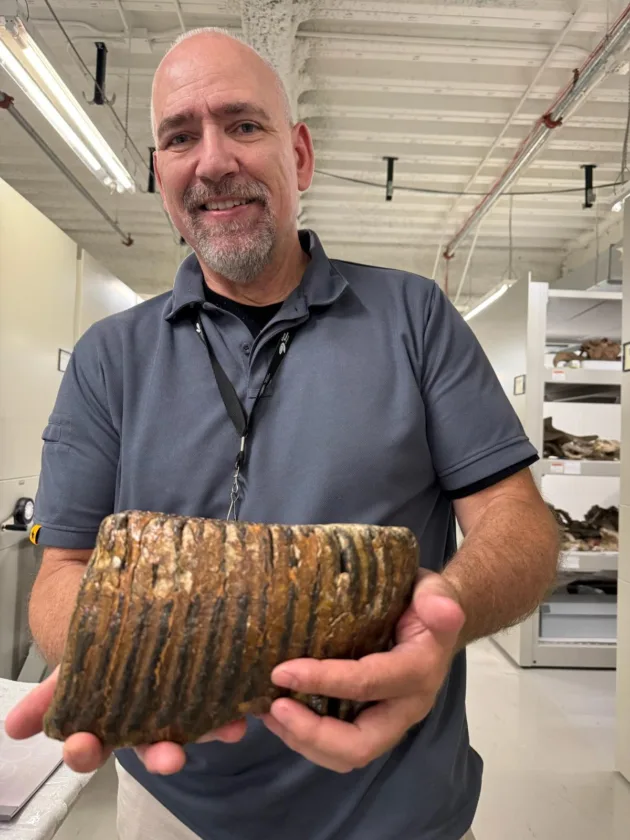
Marcus Brandel holds the 1929 mammoth molar at the Science Museum of Minnesota in St. Paul. The specimen, found west of New Ulm by August Hummel, was recently rediscovered after being absent from public records for nearly 80 years. (Photo provided by Marcus Brandel)
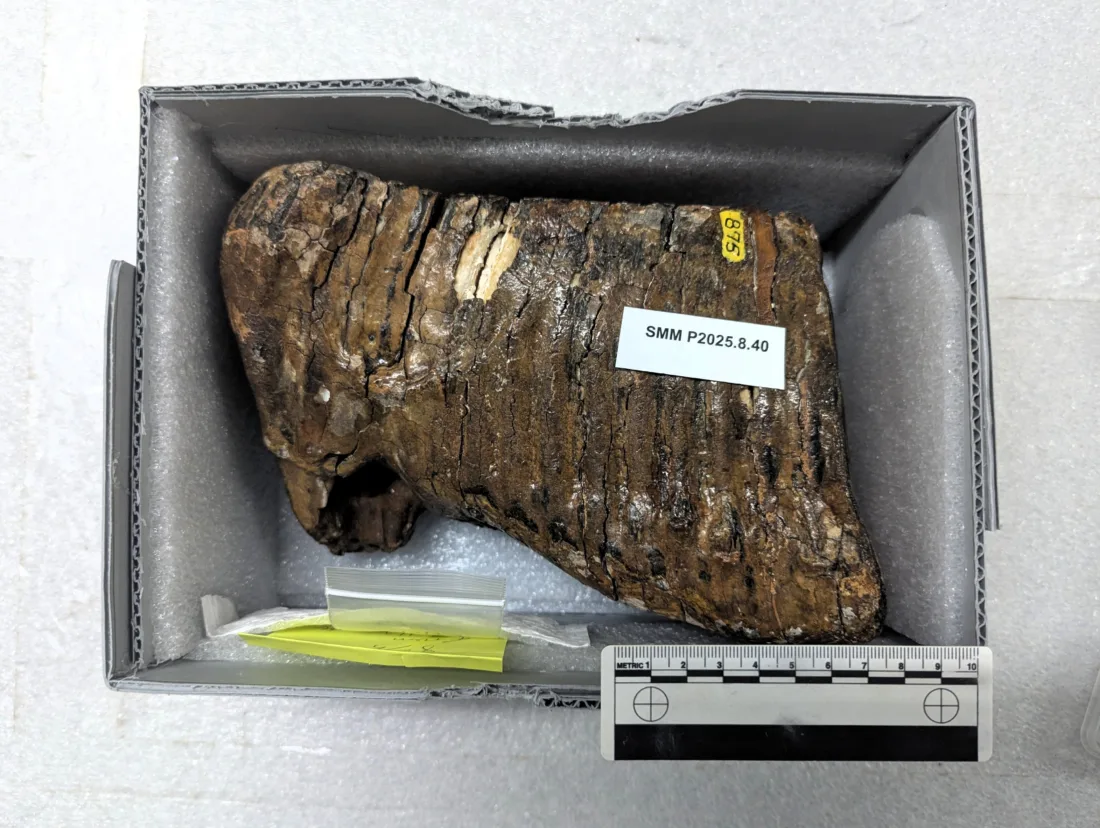
The molar is now cataloged as SMM P2025.8.40 at the Science Museum of Minnesota. The yellow tag shows its earlier Bell Museum number, 875. (Photo by Marcus Brandel)
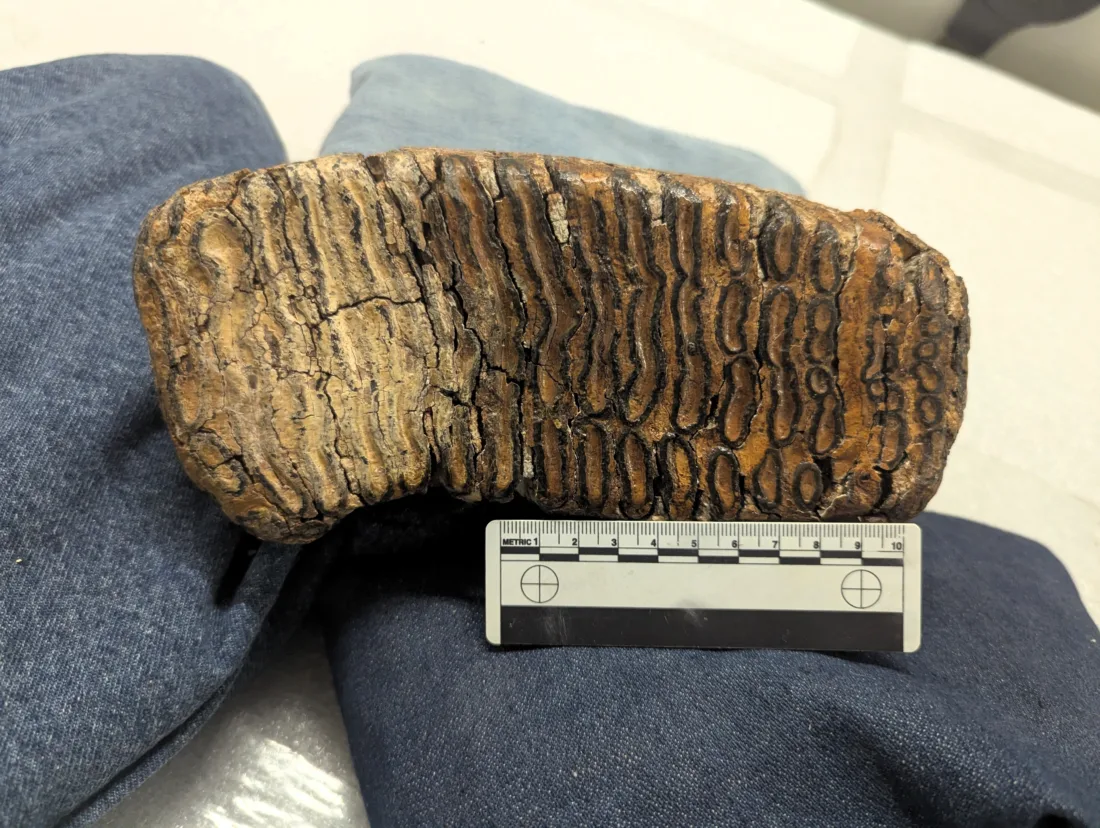
The grinding surface of the molar shows the thick enamel ridges typical of Columbian mammoths. (Photo by Marcus Brandel)
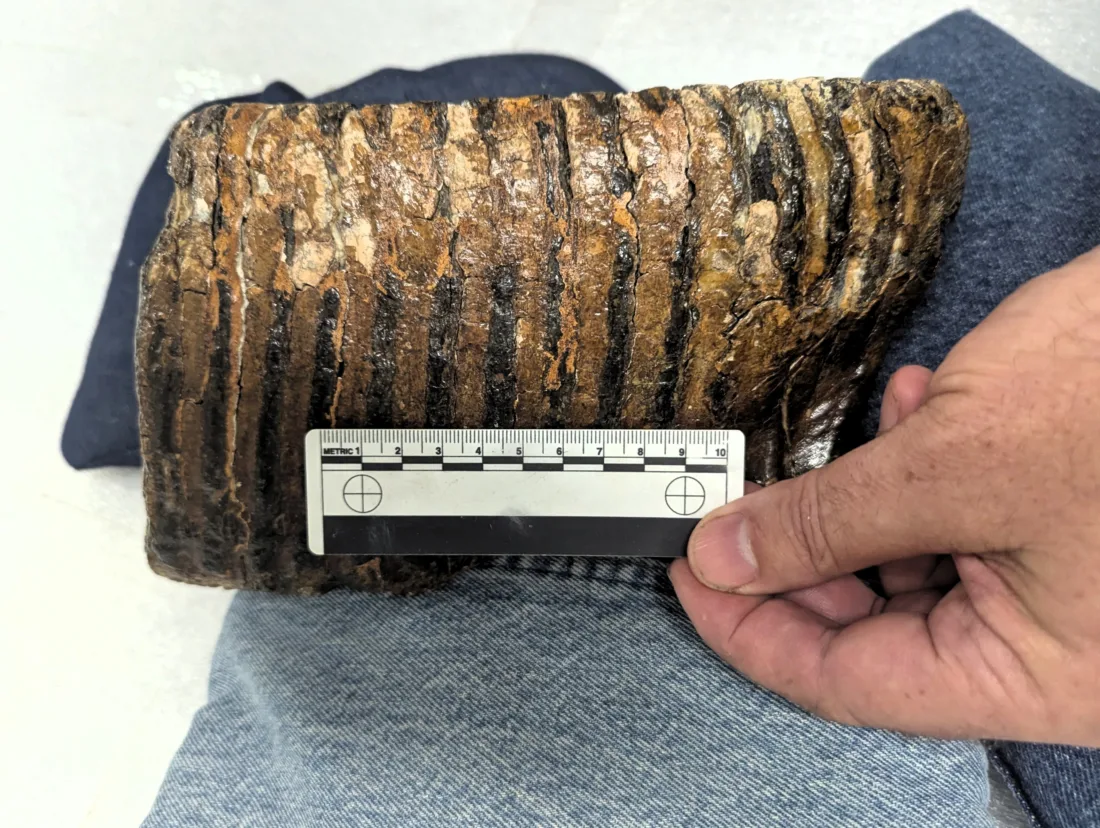
The mammoth molar measures about 21 centimeters (8.25 inches) long and weighs 9.5 pounds. A scale bar shows its size. (Photo by Marcus Brandel)
Marcus Brandel holds the 1929 mammoth molar at the Science Museum of Minnesota in St. Paul. The specimen, found west of New Ulm by August Hummel, was recently rediscovered after being absent from public records for nearly 80 years. (Photo provided by Marcus Brandel)
The molar is now cataloged as SMM P2025.8.40 at the Science Museum of Minnesota. The yellow tag shows its earlier Bell Museum number, 875. (Photo by Marcus Brandel)
The grinding surface of the molar shows the thick enamel ridges typical of Columbian mammoths. (Photo by Marcus Brandel)
The mammoth molar measures about 21 centimeters (8.25 inches) long and weighs 9.5 pounds. A scale bar shows its size. (Photo by Marcus Brandel)
Trending
NEW ULM -- A mammoth molar recovered west of New Ulm in 1929 has been located in a paleontological collection transferred from the Bell Museum of Natural History to the Science Museum of Minnesota.
The discovery closes a nearly eight-decade gap in the specimen's documented history after a seven-year search by independent researcher Marcus Brandel of New Ulm.
Local historian and preservationist August Hummel (1870-1967) found the specimen in an old river channel west of New Ulm in 1929.
Hummel documented New Ulm's pioneer history and the U.S.-Dakota War, compiling the 1922 historical statement "Historic Facts Relating to Indian Outbreak of 1862."
He also helped document the origins and boundaries of Brown County and became a founding officer of the Brown County Historical Society when it was organized in 1930.
Following the discovery, Hummel donated the molar to the University of Minnesota Geological Museum in Minneapolis, then a principal repository for geological and paleontological finds from around the state.
Museum staff cataloged it as Specimen No. 3991. The molar weighs 9.5 pounds and measures 21 centimeters (8.25 inches) long.
It was unearthed 14 feet below the surface in sediment filling an ancient riverbed.
Clinton R. Stauffer formally recorded the specimen as Entry No. 59 in his 1945 statewide paleontology survey, “Some Pleistocene Mammalian Inhabitants of Minnesota.”
Stauffer identified it at the time as “Parelephas jeffersoni,” sometimes referred to as “Jefferson's mammoth,” an early scientific name applied to the Columbian mammoth, a large species that lived in North America during the Pleistocene epoch, commonly known as the Ice Age.
After the 1945 publication, Specimen No. 3991 disappeared from public records and remained out of scientific view for nearly eight decades as University of Minnesota buildings and collections changed.
Brandel, an independent researcher and former New Ulm resident, began searching for the Hummel molar in 2019.
He studies Minnesota's scattered Ice Age megafauna finds, focusing on historic specimens that can facilitate new scientific research and those that may have been misplaced over time.
"I grew up outside New Ulm and never realized how many Ice Age fossils were under our feet," Brandel said. "Then in 2019 my friend William Eibner sent me an image of a partial mammoth tooth discovered on the Cottonwood River. I was immediately interested in the Ice Age history of the area and once I started looking, the Hummel tooth kept coming up in the old records, but no one seemed to know where it actually was. Being from New Ulm, I immediately wanted to track it down."
Beginning with the 1945 Stauffer reference, Brandel attempted to track the molar's whereabouts.
He discovered that the University of Minnesota's General Museum developed during the late nineteenth century and that its geological, zoological, and botanical collections were later separated, making it difficult to determine which collection may have ended up with the specimen.
The biological collections later moved into the original Bell Museum's Church Street building in Minneapolis, while material from the Geological Museum was eventually dispersed among university departments and other museums.
When Brandel contacted the University of Minnesota in 2019, staff said they could look for the specimen but indicated that the paleontology collection was not digitally cataloged. Locating it could require a physical search through multiple collections and thousands of specimens.
Over seven years, Brandel contacted various University of Minnesota departments, examined Stauffer's original documentation at the Gale Family Library in St. Paul, and corresponded with paleontologists and museum curators across the state.
He attempted to trace the former Geological Museum's holdings into other repositories, including the Bell Museum and the Science Museum of Minnesota in St. Paul.
"In statewide research, you become familiar with the institutions, archives, and historical museum cataloging practices where the passage of time itself can cause important fossils, like 3991, to slip through the cracks," Brandel said. "Paper records get reindexed, collections move between departments, and old tags get lost or don't always transfer cleanly into digital systems."
Ultimately, email correspondence with the Science Museum of Minnesota, and the attention to detail by museum staff, led Brandel back to the molar.
In April 2024, he was in contact with Science Museum of Minnesota staff after learning the Bell Museum would transfer its Ice Age collection to the Science Museum of Minnesota.
Brandel knew that each item in the transferred collection would be re-cataloged and given a new specimen number. U of M Specimen No. 3991 was documented on the ledger transferred with the collection but had been missed by the students who were inventorying and packing specimens for transfer.
In June 2026, Science Museum of Minnesota collections assistant Grace DeVault, who had been corresponding with Brandel, recognized the 3991 designation on the ledger as she unpacked the Bell Museum material.
DeVault then confirmed and completed the catalog transfer, re-designating from U of M Specimen No. 3991 to Bell/MNH (Museum of Natural History) 875, to Science Museum of Minnesota (SMM) P2025.8.40.
DeVault and Dr. Alex Hastings, Fitzpatrick Chair of Paleontology at the Science Museum of Minnesota, invited Brandel to examine the molar.
The rediscovery of Hummel's find adds documented context to New Ulm's geological and paleontological past. New Ulm and today's Minnesota River lie within the ancient Glacial River Warren's massive river basin, which reaches up to five miles wide in some places.
This expansive valley was shaped by glaciers and enormous flows of meltwater at the end of the last Ice Age.
The repeated advance and retreat of ice sheets across the state scoured and redistributed gravel and sand deposits and created river channels and wetlands where the remains of mammoths, mastodons, and ancient bison could be buried and preserved.
Later erosion sometimes exposed or redeposited durable remains such as bones, tusks, and mammoth teeth.
Gravel deposits across Brown County have periodically yielded remains of mammoths, mastodons, horses, and ancient bison.
Brandel has documented nearly a dozen mammoth finds alone from the area. Mammoth molars, with thick enamel ridges adapted for grinding tough grasses, are among the most durable parts of the skeleton and frequently survive well in river sediments and gravel deposits.
Hummel's 1929 recovery remains one of the earliest documented paleontology finds from the immediate New Ulm area.
Brandel recently published several articles on New Ulm's natural history as part of his "Lost Bones" series on Substack, which documents historic fossil recoveries across Minnesota. Several of the specimens in these accounts are from New Ulm.
"This wasn't just about finding a tooth," Brandel said. "It was about connecting August Hummel's work as a local historian to the scientific record so the story would not remain lost. Museums across Minnesota hold so many objects with both scientific and historical value and many stories still waiting to be told."
U of M Specimen No. 3991, now cataloged as SMM P2025.8.40, is housed in the Science Museum of Minnesota collections in St. Paul. Its catalog history has been thoroughly documented to ensure August Hummel's specimen remains traceable for all future research.
The molar rediscovery reconnects Hummel's preservation work with the scientific record and shows how historic museum collections can continue to yield new knowledge.
Marcus Brandel is an independent researcher and historical nonfiction writer. He volunteers with the Science Museum of Minnesota and the Hill Annex Paleontology Project, and his research on Minnesota's fossil record is published at marcusbrandel.substack.com.