
Saffert Provision Market: The End of an Era
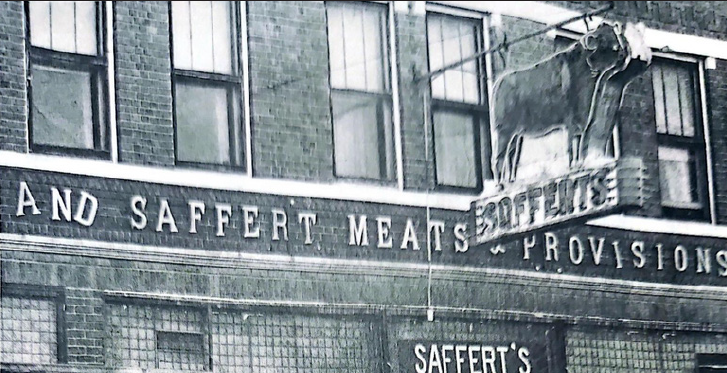
Above left: The exterior of Saffert’s which will close its doors with an auction on Nov. 13.
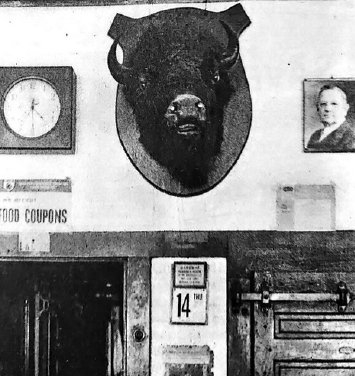
Above right: The head of a bison hangs behind the meat counter at Saffert’s. The Bison was slaughtered on a farm near New Ulm and processed at the market about 1920.
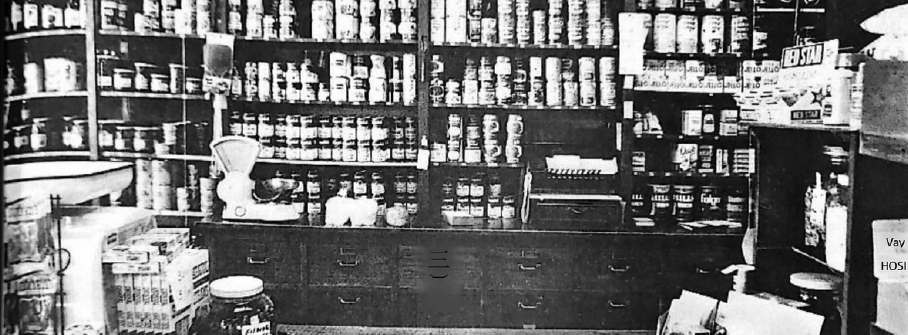
Left: Saffert Provision Market is characterized by products stacked on high shelves behind the counter. Photos by Art Hanson
Above left: The exterior of Saffert’s which will close its doors with an auction on Nov. 13.
Above right: The head of a bison hangs behind the meat counter at Saffert’s. The Bison was slaughtered on a farm near New Ulm and processed at the market about 1920.
Left: Saffert Provision Market is characterized by products stacked on high shelves behind the counter. Photos by Art Hanson
Trending
Friday was a typical day at the Saffert Provision Market, 217 N. Minnesota.
In the office, Mrs. Jerome (Loretta) Erler took grocery orders over the telephone.
At the meat counter, Mrs. John (Rose) Schuler trimmed steaks and wrapped meat.
Richard Schuler waited on customers, and filled the wooden boxes that Harley Vogelpohl would deliver around town later.
THE SCENE was a collector's item, a view to remember and store away. Saffert's is closing out. Signs mark merchandise at discount. An auction of everything left is scheduled Nov. 13.
When the cash register has rung up its last sale sometime next month, New Ulm no longer will have a store exactly like Saffert's, which was the survivor of the merchandising methods of a past era.
There were no check out lanes. No carts to be filled and wheeled to a numbered passageway, where a girl in uniform reeled off the cost on an electronic calculator.
At Saffert's, as had been done at the turn of the century, a clerk waited on you. He or she might add up the cost on the inside of the wrapping paper.
You could charge.
Food orders could be delivered to your house.
Cereal boxes, toilet paper and other light items were stacked on high shelves and removed by a long-handled tool that had a gripper on one end and a tipper on the other. Boxes were caught as they fell when the tipper was used.
LOOKING DOWN from the back wall was the head of a bison (buffalo) that had been slaughtered on a farm near New Ulm some 60 years ago. The head was mounted. The meat sold at Saffert's.
"My father used to take me in the store when I was little girl," said Mrs. Geraldene Wilfahrt."I would admire the buffalo head, and he told me the rest of the animal was behind the wall; it was only the head sticking through. One day I slipped behind the counter, through the door to the butchering rooms, to prove to myself he was only kidding."
Also on the wall was the picture of Andrew Saffert, an immigrant boy from Bohemia, Germany, who arrived in New Ulm by train June 6,1891, and applied for a job at the meat market owned by Meinrath Epple. Andrew got the job, and worked in the building his entire lifetime. He bought out Epple in 1902, and built the business in to probably the largest provision market in New Ulm.
A story in The Journal in 1940 reported that he had 11 employees, and his trucks delivered his specialty sausage and meat products into a 75-mile radius to 47retail outlets.
Rose Schuler and Loretta Erler are the last of the Saffert family,children of Andrew, still in the business. They have sold the building to Don Veigel for a potential expansion of the Kaiserhoff.
BEFORE THE supermarkets came to New Ulm in 1952 and began to dominate the food business, more than a dozen small grocery-meat stores operated in the community.
The stores, some of them "neighborhood stores" and others the "mama and papa stores," were all over town. All are gone. They included:
Arndt's Grocery, 702 N. Jefferson. Wallahei, 12th S. and Franklin.
Berg's Market, basement Herberger's.
Brey's Grocery, Second N. and Minnesota.
Schnobrich's, 117 S. Valley.
Kloeckel & Penkert, 22 N. Minnesota
Nun's, Third N. and State.
Mark's (latter Nippie's), 827 N. Broadway.
Ruemke, 226 N. Minnesota.
Vernie's (formerly Vetter's) Fifth N. and State.
Tauscheck grocery, 526 S. Minnesota.
Ralph's Red and White occupied south half of the City Meats.
Bartl's at Fourth S. and Minnesota.
Red Front Grocery on N. Minnesota between Center and First N. Leo Sprenger's, Fifth N. and Minnesota.
Beyer's grocery, 121 S. Valley.
There were others last in memory.
NORBERT (BOB) HERZOG, who retired after working 43 years for Saffert's Market, got his start working for the Red Front grocery.
"They had a huge business," he said."They had two delivery trucks, one for the north side and one for the south."
Only one neighborhood store survives -- Domeier's at 1020 S. Minnesota. It is a mama--daughter shop, operated by Mrs. Emil Domeier and her daughter, Marlene. They have some groceries,but specialize in candy and gifts from Germany, and call their place "Domeier's German Store."
New Ulm Daily Journal
Oct. 19, 1976