
College students digging into history of the Dakotas
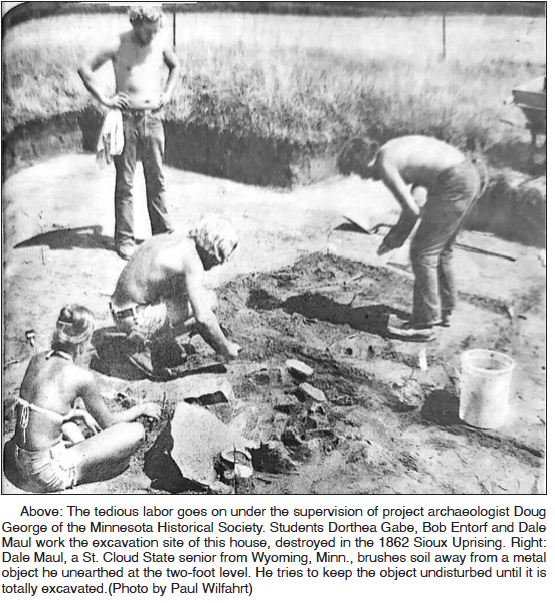
The tedious labor goes on under the supervision of project archaeologist Doug George of the Minnesota Historical Society. Students Dorthea Gabe, Bob Entorf and Dale Maul work the excavation site of this house, destroyed in the 1862 Sioux Uprising.
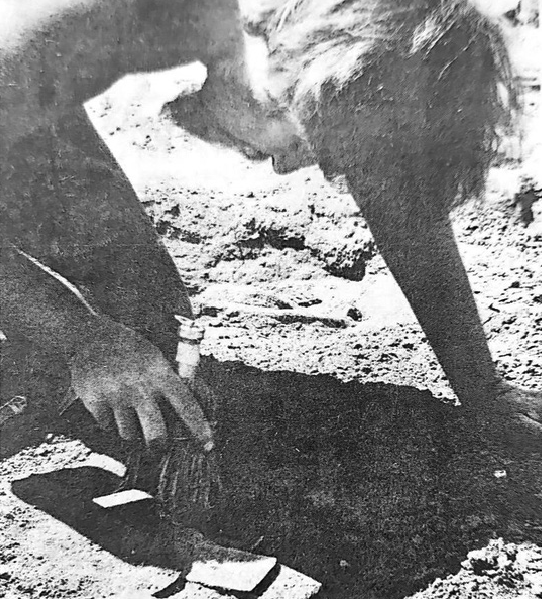
Dale Maul, a St. Cloud State senior from Wyoming, Minn., brushes soil away from a metal object he unearthed at the two-foot level. He tries to keep the object undisturbed until it is totally excavated.(Photo by Paul Wilfahrt)
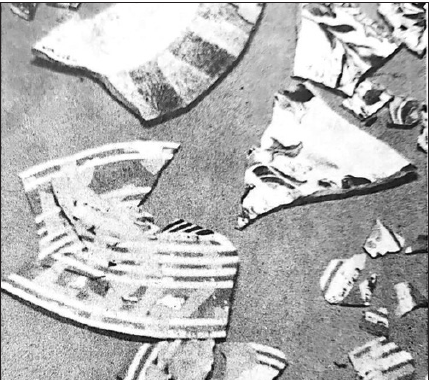
Several artifacts excavated in a cross trench in the Trader’s Area near the Lower Sioux Interpretive Center.
The tedious labor goes on under the supervision of project archaeologist Doug George of the Minnesota Historical Society. Students Dorthea Gabe, Bob Entorf and Dale Maul work the excavation site of this house, destroyed in the 1862 Sioux Uprising.
Dale Maul, a St. Cloud State senior from Wyoming, Minn., brushes soil away from a metal object he unearthed at the two-foot level. He tries to keep the object undisturbed until it is totally excavated.(Photo by Paul Wilfahrt)
Several artifacts excavated in a cross trench in the Trader’s Area near the Lower Sioux Interpretive Center.
Trending
It was 114 years ago, on Aug. 18,1862, that the large body of Dakota Indians surrounded the settlement on the Lower Sioux Agency. Twenty citizens were slain, and the buildings, abandoned or damaged by fire, slowly crumbled into ruins.
Over the past 100 years the Minnesota prairie has reclaimed the site, covering with sand, soil, and vegetation the material remains of a people, their settlement, and their activities.
NOW, FOR the third time since 1973, nine St. Cloud State University students are working with the Anthropology Department Field School to uncover information about the time before the Dakota Uprising of 1862. Location for their studies is the Lower Sioux Agency near Morton.
The students are excavating a home site under the auspices of The Minnesota Historical Society. Project archaeologist for the state is Doug George.
"This is our third year of excavations on the agency," George said. "Groups of students spent five weeks and ten weeks during the summers of 1973 and 1974, respectively, excavating cellars and homes south of this site."
DURING THE current expedition the group will explore the remains of a cellar of one of the 15 to 20 homes believed to have been standing at the time of the uprising.
"This particular cellar measured 19 feet by 29 feet," George said."Our use of probes has shown the cellar was about 41/2 feet deep." He further speculated that the upper portion of the home may have been somewhat larger than the excavated basement.
"We are searching for the artifacts and form of the structure. We have virtually eliminated the possibility of the house being a sod building. It was probably of log construction."
The groups of archaeology majors also have tested a location 1/4-mile west of the house site, referred to as the "Trader's Area." Students have dug eight exploratory cross trenches in the trader's area searching for artifacts. Items found have included pottery, plates, and many pipe parts.
"It seems that a major pastime of the area residents was pipe smoking," George said.
ORGANIZER AND leader of the student group from St. Cloud is Dick Lane, an instructor in the Anthropology Department.
"All students majoring in Archaeology are required to take course work entitled 'Field Methods in Archaeology'," Lane said. Work runs the gamut of archaeological procedure: finding a site, digging, washing, cataloging, and interpreting. All students participate in every aspect of the dig.
"Of particular interest to me,"Lang stated, "is the finding of some prehistoric materials in the area. It appears that this site has been inhabited for thousands of years. Certainly the locale has all the necessities of life, including game, ample water, and forest enough to complement the prairie."
Lane enjoys searching for settlement patterns. He sees the question of why people settle where they do as one of the many interesting questions the anthropologist-archaeologist may answer.
ALL ARTIFACTS (articles of human workmanship, such as tools, containers, ornaments, or clothes), as well as building, monument, and human remains, are sent to a large, nearby quonset hut for cataloging. Each site is excavated in 5-foot by 5-foot squares, 6 inches deep.
Items are cataloged noting the area and level in which they were found. When sterile subsoil is found, it is left undisturbed. Soil removed from the digging is sifted through one or more screens of varying sizes to remove minute objects missed with shovels or hand tools
The archaeological dig is expected to take a total of 10 weeks. George states that a slight extension could become a reality if the site proves bountiful.
The students, almost all of them to be seniors this fall, work long days at the excavation site. Even most of their free time is spent at the main excavation. A few, however, have small digs in progress
The location of the excavation is ¼ mile east of the Lower Sioux Agency Interpretive Center.
Brown County Journal
Aug. 5, 1976