
New Ulm EMS responded to 2,170 calls in 2025
Trending
NEW ULM -- Allina Health EMS New Ulm responded to 2,170 calls for service in 2025, including 911 emergency responses, interfacility transports, discharge rides and special event coverage.
Of that total, 1,197 were 911 emergency responses, according to Mark Newman, Supervisor of EMS Operations Programs for Allina Health.
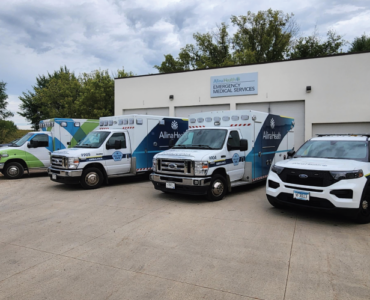
New Ulm maintains three ambulances and is typically staffed to keep two ambulances in service 24 hours a day, seven days a week. Personnel work 13-hour shifts to provide continuous coverage.
Ambulances are staffed with a combination of paramedics and EMTs providing Advanced Life Support care to New Ulm and the surrounding service area.
New Ulm also holds a part-time Advanced Life Support license, which allows an additional Basic Life Support ambulance to be staffed as needed based on staffing and demand.
"This flexibility helps ensure the service can adapt to fluctuations in call volume, special events, and community needs while maintaining reliable emergency response coverage," Newman said.
Within the city of New Ulm, average response time was seven minutes and four seconds from the time a call was received by the communications center until an ambulance arrived on scene, Newman said. The average time from dispatch to arrival was five minutes and 47 seconds.
Allina Health EMS clinicians maintain both Minnesota state certification and National Registry certification. EMTs must complete 40 hours of continuing education every two years and paramedics must complete 60 hours to maintain National Registry certification. Those hours can also be used to meet Minnesota recertification requirements, Newman said.
New Ulm paramedics are also credentialed as Advanced Trained Providers, a level of training between traditional Advanced Life Support and critical care transport.
"This additional credentialing allows New Ulm crews to safely manage higher-acuity inter-facility transports, including patients receiving blood transfusions, multiple medication infusions, obstetrical patients requiring advanced monitoring, and patients supported by mechanical ventilators," Newman said.
Paramedics are required to maintain Advanced Cardiac Life Support certification and all providers maintain Basic Life Support certification.
Beyond emergency response, the service provides medical coverage for about 40 community and special events each year,including contracted services and community-benefit activities. Those include National Night Out, school and daycare visits, community demonstrations, demolition derbies, motorcycle flat track races, hill climbs and high school and college football games.
"Our commitment extends beyond answering 911 calls," Newman said. "We strive to provide high-quality, compassionate care and community support 24 hours a day, 365 days a year for the residents, visitors and healthcare partners we serve."